“Hair is everything,” Phoebe Waller-Bridge declares in an epic monologue to her hairdresser in “Fleabag.” It’s a symbol of power, a symbol of fertility, and—perhaps most of all—it is “the difference between a good day and a bad day.”
Now, you might say that’s giving hair too much credit. As someone who’s spent the equivalent of a down payment on a house and endured innumerable hours of pain and discomfort in the name of hair, I assure you it is not. I want my hair to reflect who I am, how I see myself, and how I want the world to see me.
Society is quick to draw conclusions about who we are based on how we look.
Take Leander, our May 2026 Man of the Month, whose smooth, almost feminine face stands in stark contrast to the tufts of untamed hair that cover the rest of his skin. Comments ranged from celebratory (“20/10 for bringing back sideburns and natural hair…”) to confused (“What’s with the hair?”) to simply “No.”
The response to hair is so divisive it would seem biological. It’s not. Body hair does correlate with testosterone, which is associated with masculinity. But how we feel about it—whether we find body hair sexy or revolting—comes from deep preconceptions about what it means to be a man.

Leander • Photo: Steven Kohlstock.

Leander • Photo: Steven Kohlstock.
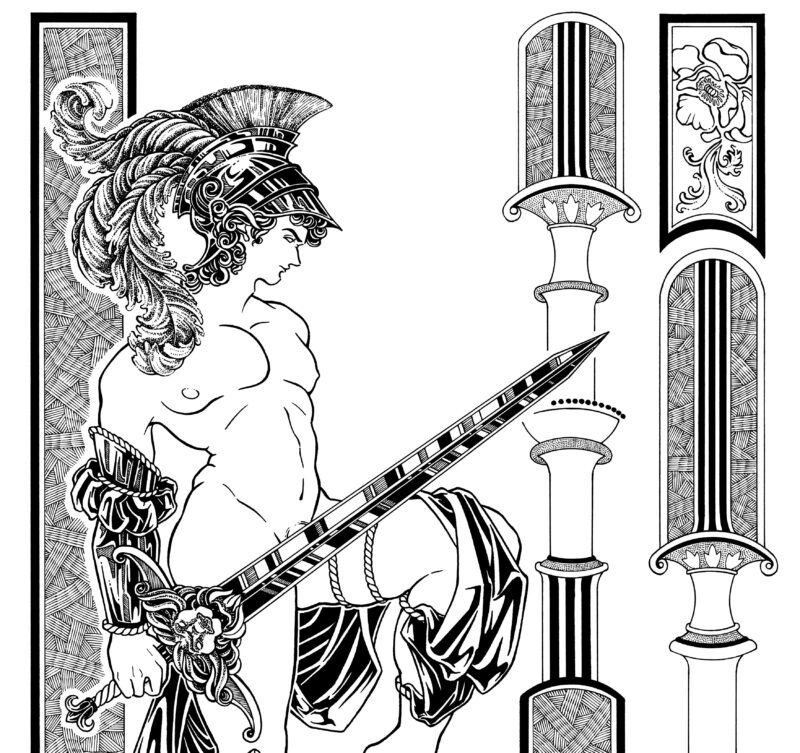
In ancient Greece hair was a marker of maturity and a rite of passage.
When a man grew a beard, it was a sign that he was ready to serve in the military and mentor younger men on battle, participation in civic society, and even sex. The pederasty system identified the elder (known as erastes) by his beard. Is it any coincidence that the word for maintaining one’s hair, “grooming,” became one associated with mentorship?
Shaving was used for strictly practical purposes (the prevention of lice among soldiers or chafing among athletes) until Alexander the Great. The king thought a clean shave showed vigor. Soon, the hairless look spread across the Mediterranean.
Unsurprisingly, as time went on, people rebelled. Hellenistic philosophers grew out their beards as a rejection of what they saw as a superficial value system, and a beard came to signify a life of the mind.
From then on, hair became symbolic. What exactly it symbolized, however, was in constant flux.
Hair lends itself to symbolism. Before modern science and technology, it was one of few parts of our bodies we could mold to reflect our image.
A carefully constructed grooming choice—whether scruff, smooth, or somewhere in between—has value. But its stock goes up or down depending on factors often out of our control. At times, hair has signified virility and power or primitiveness and violence; hairlessness has implied refinement and discipline or effeminacy and submission. The difference came down to race or ethnicity, sexual orientation, and when you were born
Rebecca M. Herzig, author of the book Plucked: A History of Hair Removal writes that, in modern history, body hair offers “a window into the perceptions, anxieties, and curiosities of the dominant culture.”
Take our founding fathers, who were a little too obsessed with the hairless bodies of Native American men. Thomas Jefferson himself pondered its meaning. According to the science of the day, lush body hair indicated a “healthy constitution.” But Humoral Theory had a sneaky way of attributing physiological conditions to moral flaws. The hairlessness among Native men then must be due to some sort of deficiency, they concluded; it made them less of men. That this bolstered the colonist agenda to seize Native lands was coincidental, of course.

Phil Barone • Photo: David Vance.
With each new era came a new grooming aesthetic.
As culture and values shift, our roles—or the roles we aspire to—within that new value system shift too. The change is represented in our grooming choices.
Following Charles Darwin’s theory of evolution, men were eager to distinguish themselves from their primitive ancestors. As body hair (or lack thereof) was the most overt symbol of our evolution, thick or abundant hair (according to 1871’s Descent of Man) was indicative of “lower” or less-evolved races.
Around the same time, another highly influential text began to take hold: Austrian author Leopold von Sacher-Masoch’s novella Venus in Furs (1870), which eroticized fur as a symbol of sexual dominance. The appeal has endured, especially in the underground, at least as long as Darwin’s.
In the early 1900s, with the rise of Endocrinology and Psychoanalysis, scientists became hell-bent on labeling “normal” sexual traits. Though they failed to define normalcy, they succeeded in sewing all sorts of (gay) panic. Hairy women were manly, hairless men (or men who groomed too much) were effeminate, and some even linked excessive body hair to criminal violence.
In 1901, King Camp Gillette patented the first safe, inexpensive disposable steel razor… just in time for American men to go to war. Beginning with World War I, every U.S. soldier was deployed with a razor in his dopp kit, and once home, he passed down the ritual to his sons. A shaven face became “a normative cultural value” (according to Gillette’s biographer) and evoked masculine notions of discipline, duty, and honor.
With both World Wars came mass immigration and, with it, racism and xenophobia.
American cities became crowded, disease spread, and cleanliness became a public health concern. A focus on physical hygiene extended to so-called social hygiene, a covert extension of eugenics that promoted hairlessness as a “desirable trait.” As middle-class homes got private bathrooms for the first time, it became easier to shave yourself, and the ability to shave signified wealth and upward mobility.
But by the 1960s, with America’s entry into its third war of the century, the shave became symbolic of the establishment. Like the Hellenistic philosophers thousands of years before, anti-war hippies, advocates of Black Power, and feminists grew out their hair in protest. The success of the 1967 musical Hair cemented the link between hair and political movements in the collective mind.

Rock Pamplin • Photo: Norbert Jobst.
From Maximalism to the Metrosexual: Hair waned over the next three decades.
In the ‘70s, more was more—especially when it came to hair. Tom Selleck was the face of Salem cigarettes, Sean Connery was James Bond, and Cosmopolitan crowned Burt Reynolds (naked on a bear-skin rug) the paragon of female desire in its inaugural 1972 centerfold. The spread helped inspire the founding of Playgirl a year later.
The “gay macho” style popularized by the Village People and artist Tom of Finland traded in the effeminate gay stereotype for muscles and mustaches. With gay liberation came greater inclusivity: The colloquial term Bear celebrated a husky, hairy look, in contrast to the sleek and slim musculature of the Twink.
Then the image of masculinity took a complete 180, when the 1977 docudrama Pumping Iron—starring Arnold Schwarzenegger in his quest to win Mr. Olympia—brought bodybuilding into the mainstream. From fitness icon Frank Zane to Sylvester Stallone in Rambo, the ideal man in the 1980s was jacked. And to show off his hard-earned muscles, he needed oiled, hairless skin.In the 90s, Mark Wahlberg posed in a series of Calvin Klein underwear ads showing off a slim, chiseled, waxed/smooth chest. The designer wanted, “straight-looking, masculine men, with chiseled bodies, young Greek gods come to life.”
The other 90s heartthrobs fell in line: Justin Timberlake, Brad Pitt, and even Eminem bared hairless chests. Playgirl’s centerfolds featured models that were increasingly more muscular and less hairy. Thanks to the Golden Age of magazines, movies, and music videos, those images captivated an entire generation of young boys and girls.

Frank Sepe • Photo: Sean Kahlil
By the end of the decade, the new sex symbol was as groomed and stylish as a gay man but apparently straight. The “Metrosexual,” writer Mark Simpson proclaimed, was epitomized by David Beckham. Male vanity was made possible, Simpson noted, due to a decline in homophobia. But also because capitalism saw dollar signs.
According to the U.S. Census Bureau, gross receipts from “personal care services” grew at a rate of 42 percent between 1997 and 2002. Hair removal set its sights on previously uncharted territory…
Enter: The Brazilian wax. Through most of the twentieth century, genital depilation was uncommon. But in 1997, when the Brazilian J. Sisters opened their salon in New York, hair down below was done for. An episode of “Sex & the City” in 2000 made the Brazilian wax a must. Within a decade, removing genital hair became nearly ubiquitous among women and popular enough among men that it got its own term, “manscaping,” from a 2003 episode of Queer Eye for the Straight Guy.
References to “bearded terrorists” after September 11, 2001, redrew a line between hairiness and violent radicalism. So out went the beard, too… until the 2010s, when a certain quasi-artist type began cropping up across the East River.
With hair peeking out from his flannel shirt, the Lumbersexual—the look associated with Brooklyn as a hipster destination—pioneered a new performance of masculinity. Despite his rugged appearance, the Lumbersexual maintained expensive grooming habits for the man’s man: beard oils, mustache wax, and premium barbershops where you could sip whiskey while you wait for your trim.
Grooming is a work in perpetual progress.
Herzig chalks up our endless fascination with hair to “the act of separating self from other.” And that work is never complete.
Today, science and technology have provided a gluttony of hair products and procedures that let us create whatever image we want for ourselves. DIY videos and the global supply chain have democratized hair care, empowering consumers to experiment at home.
Social media has accelerated trends at such a clip that anything goes, and it’s made the image we project foundational to our success: If anyone can become a celebrity, hair is as charged as ever with telling the world who we are, what we stand for, and what we stand against.
But if history can teach us anything, I’d say, it’s to question who benefits when we pour our paychecks and attention into attaining an ever-shifting image. The global men’s grooming market is projected to grow from $322.2 billion in 2026 to $506.7 billion by 2033. Hair removal and hair growth are inextricably bound to one another, in part, because the market depends on it.
In that “Fleabag” scene from the opening, the hairdresser under attack retorts: “If you want to change your life, change your life. It’s not going to happen in here.”
Use your hair to express yourself, your political beliefs, your gender identity if it makes you feel good. But remember a symbol is just that—it’s a visual representation. It can’t stand in for the actual work.