

“Hello, Johanna,” I said as she entered the dimly lit room, incense smoke sprawling into the light streaming down from the skylight. “Hello, Mr. Vox,” she replied, waiting patiently at the door.
“Step into the light, Johanna.” Bathed in the atmosphere of the afternoon sun, Johanna’s deep brow and short hair framed her face in the most cinematic way. Johanna is beautiful, and not in the traditional sense. She knows this, and she is content and confident. Johanna is an incredible woman in the world: a C-suite executive, a public speaker, a mother of three, a wife to a loving husband of thirty-plus years, a leader in her community, and the head of her household. Johanna carries a great deal of influence and power in her day-to-day life. And in here, in my space, Johanna has chosen to transfer all authority and decision-making to me, at least for today. Johanna has a few proclivities that make working with her interesting, fun, and sexy. One of them is her relationship to rope, and her desire to excavate her deepest shadows, calling in my dominance so her submissive can play in the light.
A practitioner of a different sort
I should mention what I am. I have been called a male geisha, Erotic Santa, a Sex Shaman, and I have been told, more than a handful of times, I am doing God’s work, and not just after the orgasms. While all of those titles are flattering, I am, in my own simple words, a teacher. I am a somatic sex and intimacy coach, with trainings and certifications in somatic sex education and surrogate partner therapy, seven years of experience in rope bondage and suspension, and years as a Dominant, both professionally and personally. I liken my work to a tasting menu of what is available in the erotic world; I am the chef who not only guides the tasting but crafts what’s on the table. And while this all sounds very fun and sexy, many of my clients are trauma survivors. Their ideal fantasies and desires sit far from their somatic understanding, and bridging that gap between fantasy and reality takes a great deal of time and patience on my part and theirs.
Now that that’s out of the way, where were we?
The sigh
“Take off your robe,” I say, calmly and directly. With my full attention on her, I notice everything: her heavy breath, the deep shift in her chest as her heartbeat quickens, the smell of sandalwood and bergamot mixed with yesterday’s oils, a slight trembling in her left calf. She has controlled everything in her life, managed every little bit, including the presentation of this body: Pilates, weightlifting, running, ordered meal prep. Nails kept short and clean with a light coat of polish, understated yet still managed. Curly hair, always straightened, slicked neatly back, out of the way, every time she arrives.
Now, naked in the light, I trace a thirty-foot hemp rope across her toes, up her thigh, grazing her breasts, across the back of her neck, tickling her ear. When the rope hangs equally on both sides, I pause. I clench it in both fists at either side of her neck and press down, firmly, into her shoulders.
Johanna lets out a long sigh. “Ahhhhh.” Her shoulders drop. Her eyes soften. Her entire system relaxes. Johanna is no longer managing anything. Her body remembers me, and it remembers this sensation: the release, the safety she feels when she is bound. It does not surprise me that her nervous system drops into deep relaxation almost immediately, at the first touch of the rope.
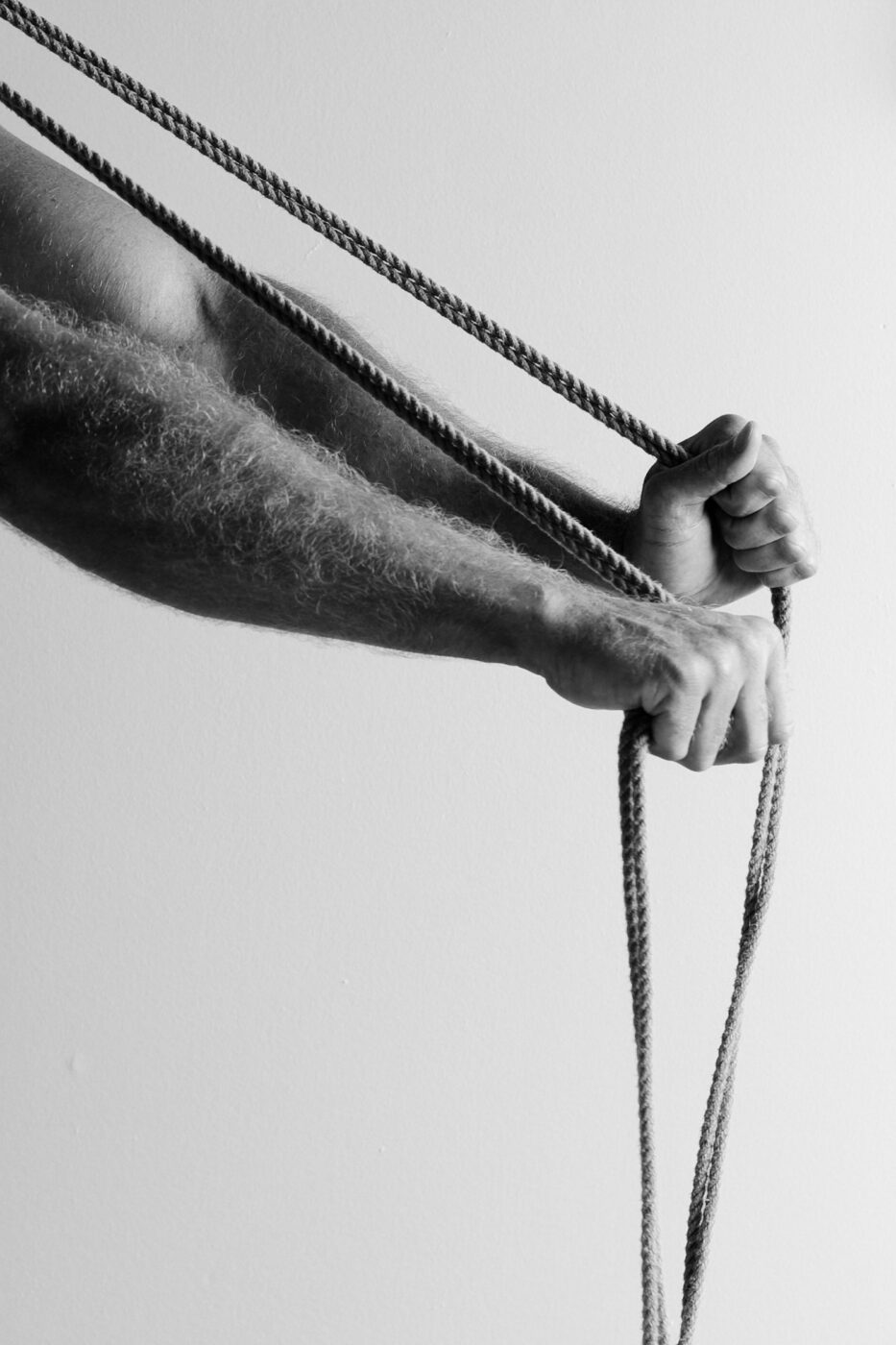
Photo: Nelson Vidals.
The science of the sigh
That sigh shows up in studies, too. Because of the stigma surrounding BDSM and rope bondage, research on the healing and regulatory effects of this modality is sparse. But it exists, and it points in one direction: rope can reduce stress, support nervous system regulation, and drop people into genuinely meditative states.
Start with cortisol, the body’s primary stress hormone. In a 2009 study in Archives of Sexual Behavior, psychologist Brad Sagarin and his team measured hormones in BDSM practitioners before and after their scenes. Cortisol climbed during play for those on the receiving end, the body registering intensity, and in scenes that went well, it dropped afterward, while partners reported feeling closer to each other than when they arrived. Stress builds, stress releases, bond deepens. Any bodyworker will recognize that arc.
Then there is what practitioners call rope space. In a 2017 study in Psychology of Consciousness, Sagarin’s lab found that bottoms enter an altered state consistent with transient hypofrontality, a temporary quieting of the brain’s executive machinery: planning, self-monitoring, time-keeping. It is the same territory distance runners and long-term meditators describe. Tops, meanwhile, showed the signature of flow. When I say Johanna stops managing, that is not a metaphor. It is a measurable state.
The biology runs deeper still. A 2020 pilot study in The Journal of Sexual Medicine found shifts in endocannabinoids, the body’s homegrown bliss molecules, in submissives after BDSM interactions, and the same journal later published a systematic review of the biology of BDSM cataloguing these hormonal and autonomic changes.
Rope also has a mechanism all its own: pressure. Decades of research on deep touch pressure, the principle behind weighted blankets, shows that firm, distributed compression shifts the autonomic nervous system toward its parasympathetic, rest-and-digest state. Randomized controlled trials have found that weighted blankets improve insomnia in people with psychiatric conditions and even reduce chronic pain. A well-tied chest harness is a weighted blanket that breathes with you, with one crucial addition: someone is paying attention. Research specific to rope is younger and mostly qualitative, like a UK case study on the therapeutic impact of rope bondage and studies of rope communities where practitioners describe calm, embodiment, and belonging. But it is remarkably consistent with what I watch happen in my spaces.
None of this makes rope a substitute for therapy, and no ethical practitioner ties a trauma survivor into surrender without scaffolding. Which is why this scene did not begin when Johanna walked through my door.
Surrender is built, not taken
Johanna has an existing relationship with me, and with rope. This is not her first time here, and she did not simply walk in and “let go” because I told her it was ok to do so. A day prior, we spoke about her desires and intentions for our time together, and about her boundaries, both emotional and physical. She expressed the desire to make no decisions, to put her body fully in my care. Outside the door, before she entered, she reconfirmed that nothing had changed overnight. Beneath those conversations sits a relationship of deep trust built over five years and many logged hours of exploration of all kinds. It was through these explorations that she discovered rope as the ultimate portal for her surrender. And it was over time that Johanna stopped showing up to work through her trauma, and started showing up to deepen her relationship to her body, to pleasure, and to play.
Trauma is a tricky animal
In Johanna’s case, if you heard her story, you might file it under “little t” trauma. She was not raped or molested. And, in her body, the experience registered as so harmful that it rendered her nearly speechless and motionless during sex. She checked out. It was a way to self-protect. What a gift the body is, to offer this mechanism of survival. And Johanna no longer wanted to accept it as her forever fate.
This is where rope earns its place in healing work. Trauma often leaves behind hypervigilance: a nervous system that never got the memo that the danger has passed, a watchman who never comes off the wall. You cannot think your way out of it; the body has to be shown, in real time, that it is safe to stand down. For a system that has spent decades scanning, managing, and bracing, the attention, clarity, and care provided in a D/s container and in this case, rope, offers something conversation cannot: a boundary it can feel, held by a person it trusts, with nothing left to manage. The vigilance finally has permission to rest.

Photo: Nelson Vidals.
The cocoon
“No effort needed here. You can let go,” I say, as I slowly, methodically wind the rope under her breasts and around her back, snaking over the top of her chest plate, under her armpits, around her shoulders, tightening as I go. With every cinch, a deeper sigh, and a deeper relationship to her breath, to the present moment, to her surrender. Over the right shoulder first, catching the band below her breasts, then weaving up over the left shoulder into a harness that frames her chest beautifully, securely. After I lock off the rope in the back, snug, I wrap my arms around her, pulling her back securely into my chest, my chin resting atop her head, extend her wrists, and bind her hands together, carrying them over her shoulders to tie behind her head. I move with her here, so she can feel the edges of herself in the rope, in my body: the places that don’t just confine her, but hold her. Keep her in.
For some, the rope is an edge of sensation, a marker that holds in a bigness that feels unmanageable, uncontrollable, like they have no energetic end. Until now. At least, this is how Johanna describes it. She does not feel trapped. She feels cocooned, held, safe. And she is not alone. Many humans feel this way in rope, including the male clients I work with. And if not in rope, they find that solace in the rules, rituals, and protocols of authority transfer. Having someone manage the details, notice everything, and pay attention with acute accuracy and care has been named, more than once, as the greatest gift I offer. Attention is our most valuable commodity, afterall.
Coming back
After hours of exploration and play, the traces of sandalwood and bergamot almost completely replaced with the scent of sweat and release, Johanna’s eyes are soft and peaceful, flirting with me through an unfurled curly mop of hair dripping over her right eye. She is messy in the most beautiful way. I move her body to the floor and ceremoniously begin to untie her, as if I was unwrapping a precious gift to give back to the world, not better, yet different than when she arrived. The untying matters as much as the tying. I unwind her slowly, and Johanna returns the way a diver surfaces: no rush, no bends. As the final rope comes off, her body begins to shake, and she weeps for just a moment of final release. “Thank you for your tears, Johanna.” My body tightly curled around hers, I begin to trace the relief the ropes have left behind. The marks on her skin will fade by tomorrow, and until then she will revel in them with pride. They are reminders of her power, her solace, her surrender. In this state we linger much longer; researchers who study this call it afterglow, and Sagarin’s data on post-scene closeness backs it up. Soon she will put the robe back on, and then the titles: executive, mother, wife, leader. She will hold it all again, carrying herself differently in the world, knowing she has the capacity and the space to take it all off when she chooses.
For one day, everything held her. That is the secret the research is only beginning to catch up to, and the one the rope has always known: for the people who carry the most, freedom does not always look like more space. Sometimes it looks like a boundary you can finally trust.
The name and details of “Johanna” are a composite, drawn from my work with multiple clients.
Based in Los Angeles, Court Vox is a Certified Sex & Intimacy Coach, Surrogate Partner, and the Founder of The BodyVox. Through his courses, workshops, retreats, and private immersions, clients cultivate tools to overcome limitations and shame, embracing a deeper sense of intimacy with their whole selves.