
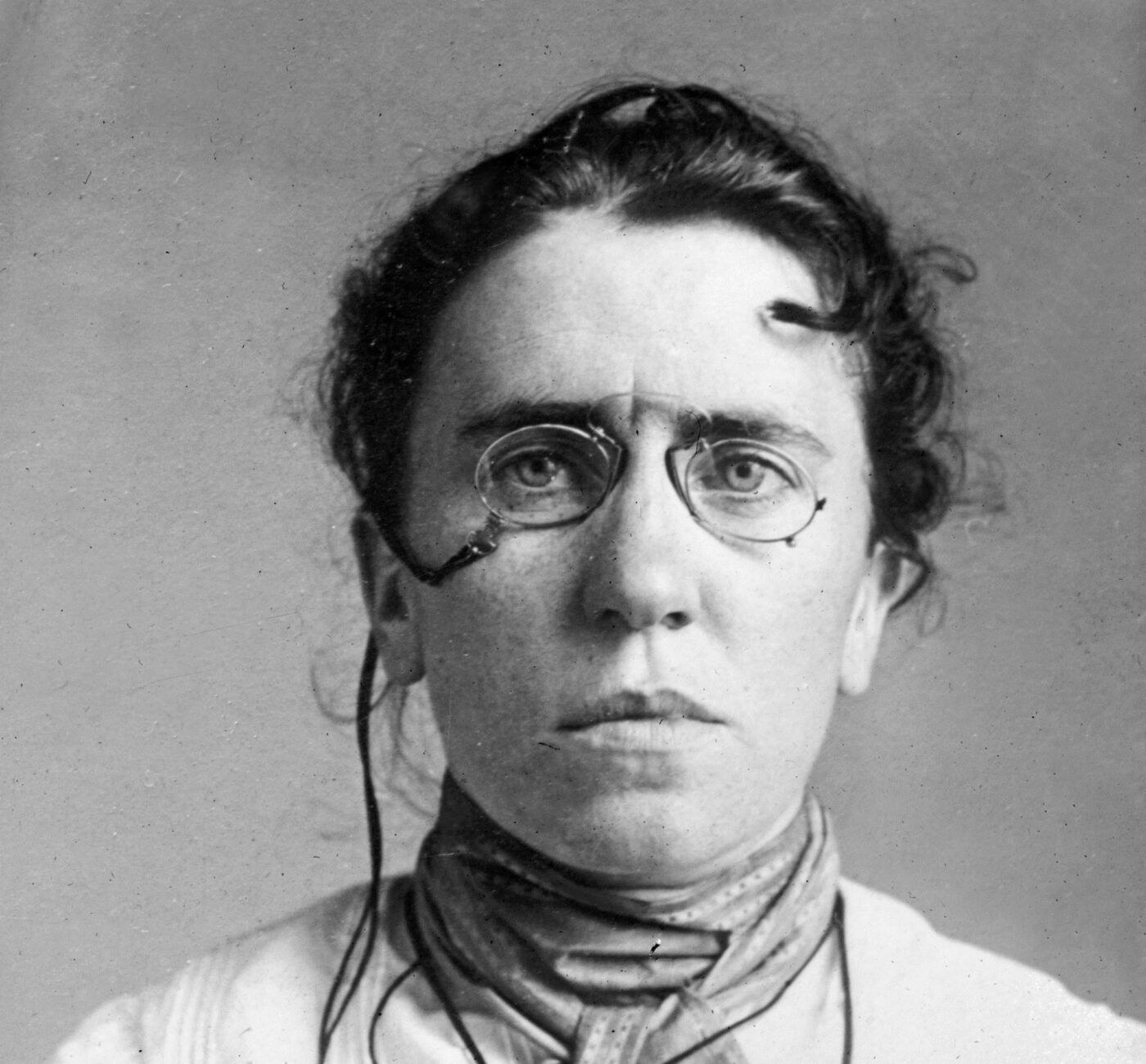
Long before bodily autonomy became a feminist rallying cry, Emma Goldman was scandalizing early 1900s America with her views on women’s sexuality and reproductive rights. At a time when “hysteria” was used to discipline outspoken women and birth control was branded “obscene,” the anarchist firebrand was delivering lectures and writing manifestos about contraception, female pleasure, and free love. And even when they landed her in handcuffs, she’d always stand by a truth that still terrifies America today. The truth that a woman’s body and will are completely ungovernable and entirely her own.
A gifted orator and persuasive writer, Goldman was a vocal proponent of individual autonomy and a fierce detractor of repressive state institutions. She tackled everything from labor organizing to anti-war activism to freedom of speech, while also championing women’s rights when many of her comrades did not. In the face of patriarchal social norms and puritanical legislation, she advocated for personal resistance against the traditional expectations and structures meant to keep women in their place. After all, Goldman wrote that a woman could achieve true freedom and independence by “refusing the right to anyone over her body” and “refusing to be a servant to God, the State, society, the husband, [and] the family” in her 1911 essay “Woman Suffrage.” And as a result, she said, a woman’s life would be “simpler, but deeper and richer.”
It was a radical idea that Goldman herself had to continually grapple with, even within her personal relationships. As she wrote in her autobiography, Living My Life, one particularly painful instance involved her partner Ed Brady, who said her fervent activism was merely misdirected maternal instinct. But Goldman declared he was “not going to clip my wings,” saying that she would still stay true to herself “even if it means tearing you out of my heart” after seven years together. So when Brady attempted suicide “‘to scare you a little and cure you of your mania for meetings,’” she finally made good on this promise before leaving on her next lecture tour with another lover.
The birth of an anarchist
Born in 1869 to a Russian Jewish family in Lithuania, Goldman grew up in an environment of persecution, where violent anti-Semitism was rife and Russian Czarist rule punished any form of dissent. By the time she immigrated to America at 16, she was already intrigued by Russian revolutionary ideals touting a society of free equals and later became influenced by the leftist politics of her fellow workers at a clothing factory in Rochester, New York. But the most pivotal point in her radicalization came in 1887 with the execution of four anarchist labor activists accused of the Chicago Haymarket Square bombing. Deeply disturbed by this event, she decided to leave her husband and move to New York City, trading in an unhappy marriage for the boundary-pushing activism that eventually earned her the nickname “Red Emma.”
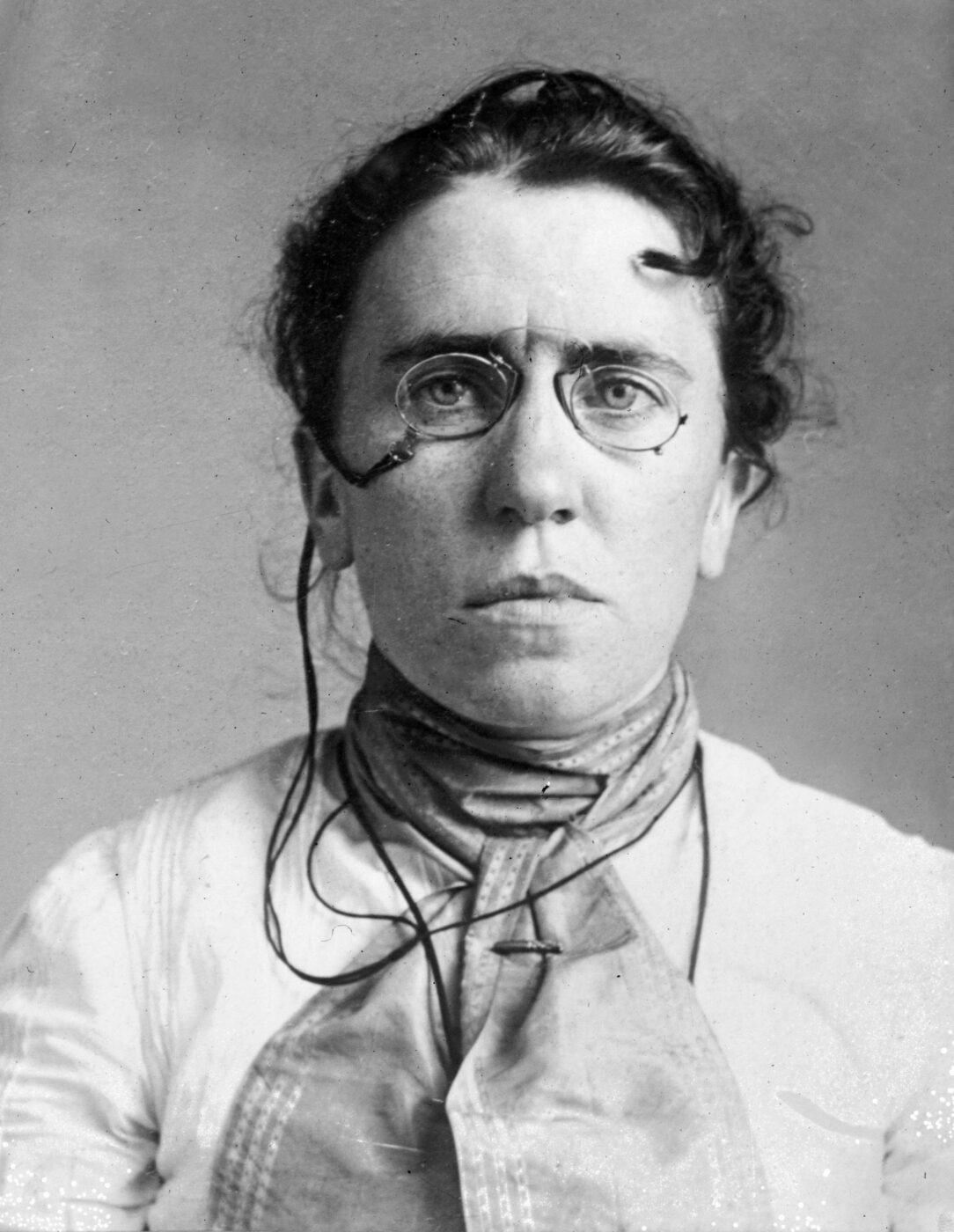
Emma Goldman • Photo: Ann Ronana Picture Library.
After officially joining the anarchist movement, she began giving lectures under the guidance of influential speaker and newspaper editor, Johann Most. A highly respected figure in radical circles, Most saw her as his protégé and expected her to parrot his views onstage. Except, Goldman wrote in her autobiography that she wouldn’t be “treated as a mere female,” telling Most after a failed lecture that “I would never again follow blindly.”
However, Most was far from the only man who found himself on the receiving end of the fiercely independent thinker’s defiance. When Goldman was sent to Europe by two benefactors to study medicine, she returned to activism, which led one benefactor to dismiss her work and say her “ideas have no meaning whatever to me.” Faced with the choice between their sponsorship and her convictions, Goldman immediately responded by telling them to keep their money, writing that “E.G. the woman and her ideas are inseparable. She does not exist for the amusement of upstarts, nor will she permit anybody to dictate to her.” Because if there was one thing Goldman made clear time and time again, it was that no man — regardless of his money or power — could ever control, silence, or compromise her core beliefs.
This self-determined mindset mirrored Goldman’s politics, which blended radical European anarchist ideas with the spirit of American individualism. She envisioned a future society built on self-organized communities of free-thinking individuals, unhindered by tyrannical governments and capitalist exploitation. To help spread this message, she founded Mother Earth magazine and worked with longtime lover and collaborator Alexander Berkman to turn it into a publication that became instrumental for 20th century anarchist theory.
Mother Earth gave the idea of a faraway anarchist utopia a wider platform, but Goldman herself was also focused on present issues and rejected the joyless dogmatism of some of her comrades, insisting that fighting for the cause didn’t have to mean denying life’s pleasures. Sexual freedom was a part of this, especially because true anarchism demands the transformation of both public and private life for all individuals. And in Goldman’s eyes, this meant the issue of sexual liberation was also central to that transformation, especially for women.
Sexual liberation as revolution
Goldman believed that sexual freedom was essential to broader liberation, arguing that puritanism destroyed natural human desires and robbed people of individual expression. Sexual freedom, in her opinion, was essential to the social harmony necessary to unite people under anarchist principles. And that meant it should also be extended to women, gay people, and anyone else denied autonomy over their own bodies.
When it came to women’s sexual liberation, one important aspect was birth control, which directly challenged religious authority, state power, and the patriarchal expectation that women’s bodies only exist for reproduction. While working as a nurse and midwife, Goldman saw many poor immigrant women already struggling to support their children and subsequently resorting to dangerous at-home abortions. The experience convinced her that contraception was necessary for women’s sexual and economic freedom, as she wrote in her autobiography. And so, she began distributing information about birth control at her lectures, which eventually led to her arrest and conviction under the Comstock anti-obscenity law.
At the same time, Goldman also championed free love and women’s right to sexual pleasure, rejecting the notion that women should suppress their desires until marriage. In her 1914 essay “Marriage and Love,” she asked what could be “more outrageous than the idea that a healthy, grown woman, full of life and passion, must deny nature’s demand [and] subdue her most intense craving” by abstaining from “the depth and glory of sex experience until a ‘good’ man comes along to take her unto himself as a wife.” Always one to practice what she preached, Goldman openly wrote about her physical attraction to multiple lovers throughout Living My Life and questioned whether monogamy was necessary. “Could one love two persons at the same time?” she wondered before concluding that it must be possible based on her own experience. And documenting her own desires and relationships in such explicit terms wasn’t just a radical act for her time. It remains a radical act to this day.
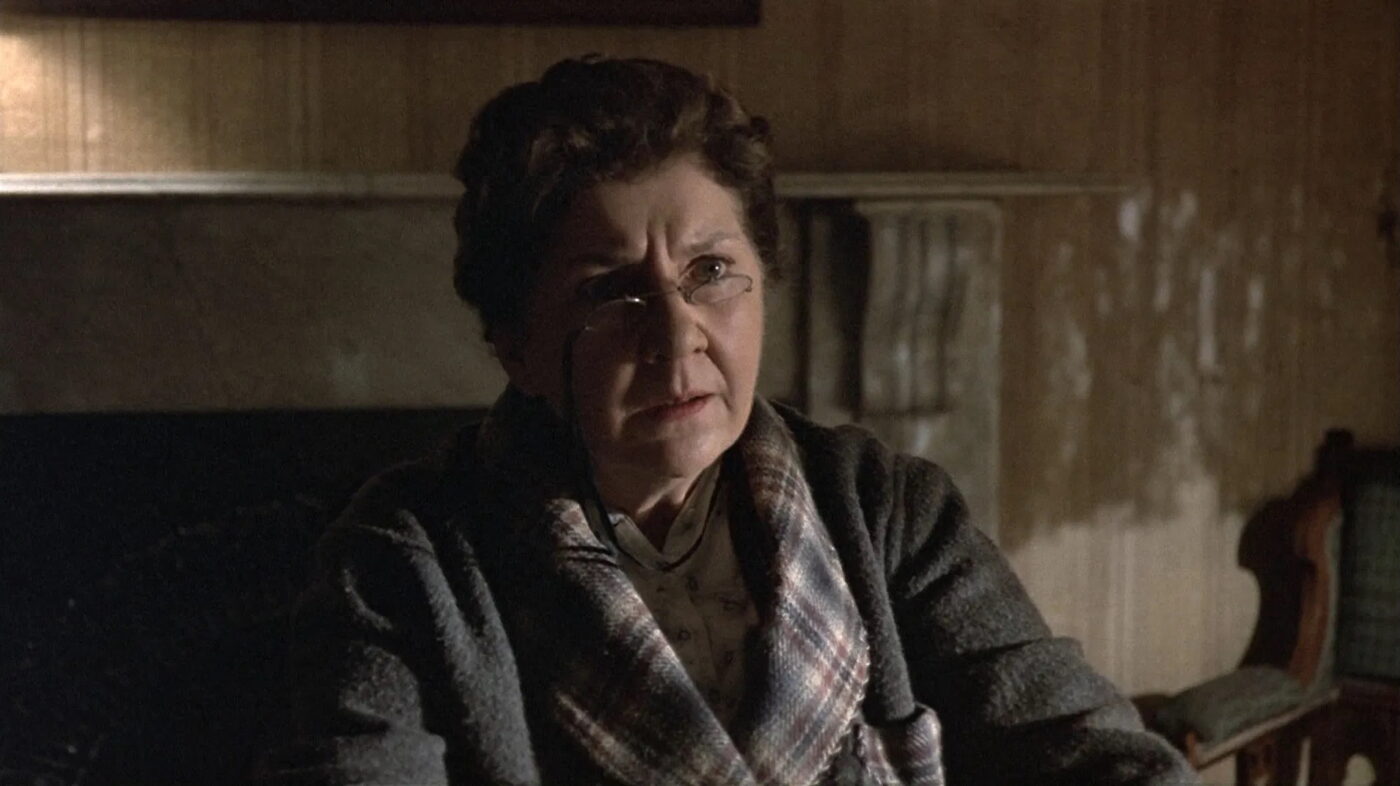
Maureen Stapleton as Emma in ‘Reds’ • Paramount Pictures.
Goldman’s legacy
Goldman’s relentless activism meant she was always a target for law enforcement, but her outspoken opposition to World War I and mandatory conscription was what led to her arrest and conviction under the Espionage Act. After serving her sentence, Goldman was deported to the Soviet Union in 1919, but found herself disenchanted by the results of the Bolshevik Revolution. She then went on to live in Europe before finally immigrating to Canada, where she passed away in 1940 at the age of 70.
Since then, Goldman has been immortalized in numerous documentaries and films, most notably Warren Beatty’s 1981 epic Reds, where she was portrayed by Maureen Stapleton in an Academy Award-winning performance. Multiple books and plays have also been based on her life, with some focusing on her relationships with lovers like Berkman and Ben Reitman. However, it’s her activism that’s always rightfully drawn the most attention and solidified her as one of the most influential radical thinkers and political organizers of the 20th century.
Goldman’s insistence that the personal was inherently political was foundational for second-wave feminists in the ‘60s and ‘70s. Many of them resonated with her call for the reorganization of domestic life, including the equal division of child-rearing labor and rejection of traditional marriage structures. To this day, her ideas continue to influence modern feminist thought around reproductive rights, sexual freedom, and liberation from patriarchal institutions, because Goldman’s version of anarchy also means dismantling the economic and social structures that keep women subordinate.
Even a century after her deportation, her vision remains incredibly relevant in a country where abortion bans have been enacted, legislators clash over contraception rights, and economic inequality strips women of choice. Her argument that bodily autonomy, sexual freedom, and economic liberation are inseparable continues to ring true, especially as we fight against a government threatening to take it all away. Because the truth that Goldman stood by in handcuffs is just as threatening today as it was over 100 years ago. The truth that a woman’s right to her own body is hers and hers alone.