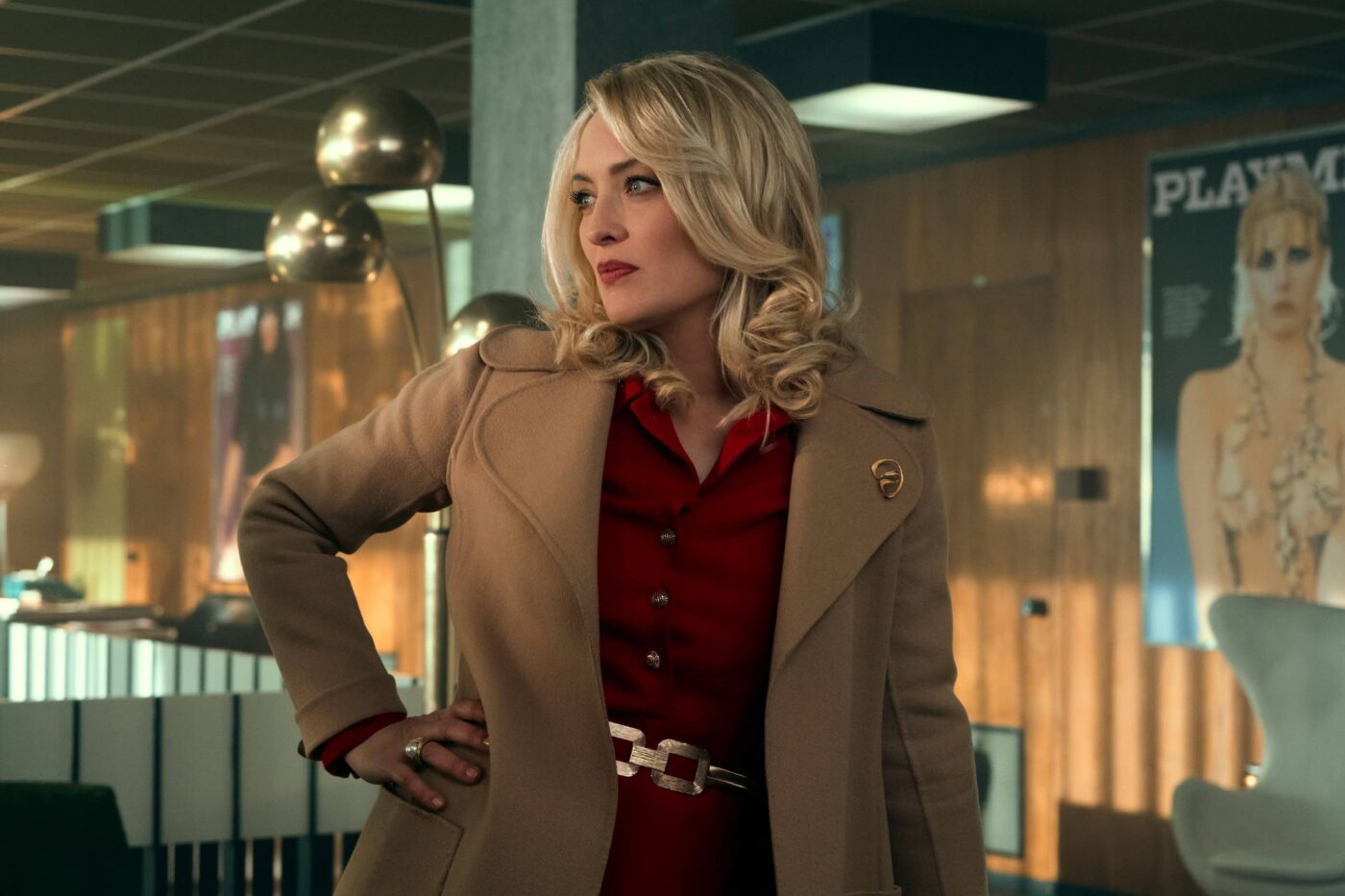
A news anchor on TV: “…The Italian publisher Adelina Tattilo who [was included] by the UN in their latest list of the world’s 30 most influential women… Tattilo* is the first and only Italian woman to receive this recognition and she joins the illustrious ranks of inspiring women like Indira Gandhi and Simone de Beauvoir. The decision to include Tattilo in that list has divided public opinion, with some insisting that Tattilo makes nothing but pornography, while others credit her with starting a minor revolution…” So begins Mrs Playmen, a 7-episodes-limited series “inspired by a true story.”
The “true story” is Adelina Tattilo’s, who founded –with husband Saro Balsamo– Italy’s first ‘nudie’ magazine in 1967 and courageously took over, after Balsamo fled to France. The “minor revolution” is Playmen’s, the erotic monthly somewhat inspired by Hefner’s Playboy (when Playboy was banned in Italy): Under Tattilo’s leadership, it defied social mores, fought the patriarchy and advanced female empowerment.
Whereas Minx, in the eponymous comedy series, is a fictional women’s erotic magazine, only loosely inspired by the real Playgirl, Playmen’s “true story,” as told in Mrs Playmen, bears factual similarities to Playgirl’s own story. Yes, one was “entertainment for men,” the other was (is) “entertainment for women.” But both featured renowned writers (Playmen Calvino, Ginsberg, Miller, Moravia, Pasolini…); both fought censorship; both were sued by Hefner; both took on thorny issues –divorce, prostitution, reproductive rights, polyamory; both braved the hostility by anti-porn feminists (“What they do is completely archaic and misogynistic,” warns an activist in episode #2. “It’s men commodifying the bodies of women.”)
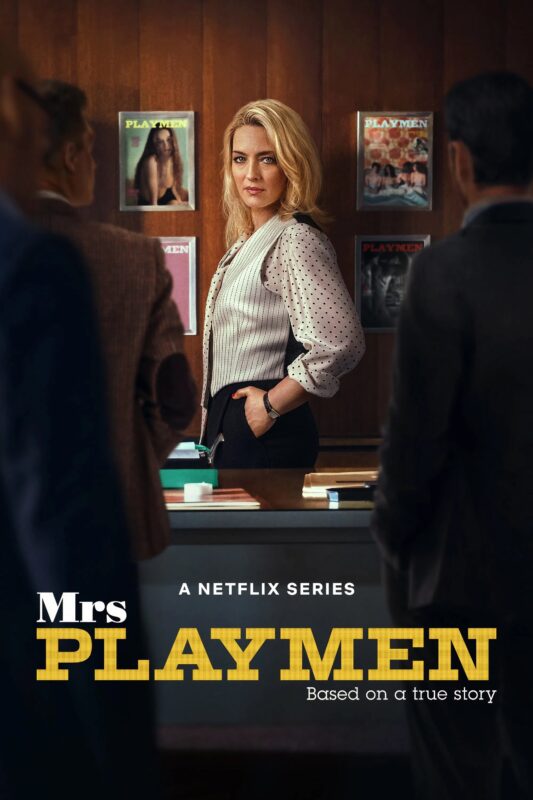
‘Mrs Playmen’
Tattilo wanted to “show them some real Italian women (…) Show them the mothers, the wives, the girlfriends, even the prostitutes (…) Women all have a strong and innate erotic sway, they don’t have to hide.” And she sought to speak to female readers: “We’ll talk sexuality and eroticism and couples.” “So, another feminist digest?” retorts the editor. “No, because those already exist,” says Tattilo in the TV series. “We should approach a segment of the public that no one has satisfied. Namely women who want to have some fun and who want their lives to feel amazing, without any taboos (…) In my conception of eroticism, women with their own desires, and the right to enjoy their own pleasure, are protagonists as much as any of you men.”
Now, compare Tattilo’s to Playgirl’s manifesto as published by Marcia Borie in 1973: “Every PLAYGIRL is liberated to the extent to which she allows herself to feel free. Free of past guilts. Free of sexual hang-ups. Free of self-doubts, free. That one word –above all others– is the key to PLAYGIRL (…) A PLAYGIRL is capable of living life to its fullest. In order to do this, her mind should be emptied of those inhibitions which may have kept her in a state of status quo for too long.”
Mrs Playmen is set in the conservative, sexophobic Rome of the 70s. But make no mistake: the battles Tattilo fought then are no less relevant today, with calls for censoring speech once again on the rise. “If we don’t try to stop it now, what comes next?” argues the DA in episode #1 –sounding like any of today’s (misguided) legislators. “They won’t stop till there’s pornography everywhere. Even in the hands of children!”
It is “inspired by a true story.” Thus, fictionalized and all too often at Saro Balsamo’s expense. Whose vision for a hardcore (explicit) publication is contrasted in the TV series with Tattilo’s stance on softcore (artistic?) imagery. By doing so, Mrs Playmen belittles Balsamo’s legacy –in 1977 he transformed Le Ore into Italy’s most popular, most read, most subversive porn magazine, bringing about a “minor revolution” of his own. And it undermines its premise. Because freedom of (sexual) expression, as Larry Flynt taught us, cannot be a matter of ‘taste.’