For some, those two words back-to-back can strike immediate excitement, while for others induce a pearl-clutching moment. Especially amongst men who identify as straight and can’t possibly fathom putting anything up there. But here’s the thing: People, of all genders and sexualities, have been having anal sex since the dawn of humankind. In Ancient Rome and Ancient Greece, anal sex was practiced as a form of birth control. Then a couple hundred years later on the other side of the world, the Moche civilization in Peru (500 – 800 AD) were doing the same, as found in depictions of varying forms of intimacy on their ceramics.
For many, it wasn’t just about preventing pregnancy. Some found anal sex enjoyable because, well, with the right partner, your favorite lube or free spit, and a willingness to try something that’s considered naughty, it can be.
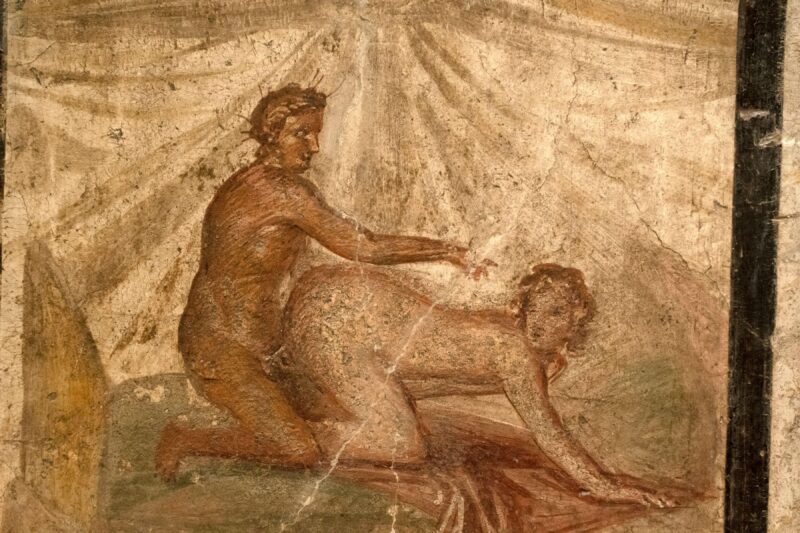
Roman fresco, Pompei. Photo: Andrea Izzotti
How Anal Sex Initially Became Taboo
Like a lot of things, we can blame Abrahamic religions—at least to a degree. According to the Bible, Sodom and Gomorrah were two cities rife with sin and debauchery. So basically, a standard Monday night in Vegas.
The cities had to be destroyed due to supposed deviant behavior —something that’s covered in Genesis 19. Those who want to use the Bible to justify their homophobic stance often point to the locals of Sodom and Gomorrah attempting sexual violence against angels (disguised as weary male travelers). But that’s only one piece of the pie. Different interpretations of what went down in those two cities point to other sins, like excessiveness, gluttony, arrogance, as well as idolatry. It’s because of these occurrences and a litany of similar activities that God had decided to destroy the city with fire and brimstone. In other words, even before the incident with the angels, Sodom and Gomorrah were already on the chopping for a boatload of infractions. Consensual same-sex behavior wasn’t even one of those.
While the Bible has long contributed to the taboo of anal sex (amongst same-sex or opposite-sex couples, or however anyone might identify), it certainly couldn’t stop people from having anal sex. After all, when people get a taste for something they like, religion has never stood in the way.
How Media Representation of Anal Sex Affects the Stigma
While it’s easy to point to the Marquis de Sade’s Les 120 Journées de Sodome written in 1785 (published in 1904), this was certainly not the only work to normalize anal sex (considering we’re talking about de Sade, his intentions were more likely shock-based.) In 1920, D.H. Lawrence published Women in Love which explored back door transcendence between women and men, and men and men. Lawrence definitely gets props for this aptly poetic terminology.
Then we have James Joyce, obviously into heterosexual anal sex with muse and future wife, Nora Barnacle. Although their letters didn’t become public until 1975, these two make Anaïs Nin and Henry Miller look absolutely boring in their sexual escapades. “You had an arse full of farts that night, darling,” Joyce wrote to Barnacle in 1908, “big fat fellows, long windy ones, quick little merry cracks and a lot of tiny little naughty farties.” As much as religion, the Church, and taboos tried to stifle anal sex, they never actually put an end to anal exploration for some—if not many (many!) people.
While anal sex isn’t exactly a common trope in movies and television, it’s there. In season one, episode four of Sex and the City, Charlotte York is faced with a dilemma: to up the butt or not. Charlotte made her concerns clear say, “Men don’t marry up-the-butt girl. Whoever heard of Mrs. Up-the-Butt? No, no, no. I can’t. I want children and nice bedding, and I just can’t handle this right now.” That was in 1998. In contrast, 16 years later on Broad City the character Ilana Wexler said, “It’s 2014. Anal is on the menu.” And she definitely wasn’t wrong. That same year The Mindy Project also tackled anal sex in the episode, “I Slipped.”
“When mainstream film and television normalize not just the act but the context around it, the communication between partners, the fact that it can be joyful and even funny and deeply intimate, that’s when real cultural shifts happen,” says Alicia Sinclair, Founder and CEO of COTR Inc., the parent company behind b-Vibe and Le Wand. “Think about how much shows like Sex Education have changed the way people talk about sexuality in general. That kind of authentic storytelling gives people permission to be curious without shame.”
But despite all the mainstream media attention and push to normalize anal sex, when Teen Vogue published a comprehensive guide to anal sex in 2017, there was an immediate backlash from parents. Some felt it was too graphic, while other claimed it encouraged unsafe sexual practice. Then, of course, there were the parents who went so far as to film themselves burning the magazines, because purchasing something to only light it on fire makes perfect sense.
Where Anal Sex Is Today
Although there are still varying sodomy-related laws in 14 states, there’s hope. According to the International Society for Sexual Medicine, roughly 36% of hetero women and 44% of hetero men have engaged in anal sex. While women tend to be on the receiving end more often, men are still open to the idea of anal play, including pegging, at 33% versus 23%, respectively. The same research also found that those who are middle-aged (40 to 59 years of age) are even more likely to give hetero anal intercourse (HAI) a try. But, again, the push to debunk myths and give our culture a chance to embrace anal sex as the normal sex act it is, comes down to normalization, which only happens through repetition and representation.
“The more we talk about anal sex openly, accurately, and without shame, in sex ed, in media, in healthcare settings, the less power the stigma holds,” says Sinclair. As Sinclair further explains, for straight-identifying men, anal pleasure can be achieved by disconnecting it from sexual identity. After all, the prostate is a gland and, therefore, doesn’t have an opinion about whom you’re attracted to. “What we need is a cultural narrative that allows people to be curious without that curiosity threatening their sense of self—and that starts with language,” says Sinclair. “Moving away from punchlines and toward honest, body-literate conversation.”
Religious doctrine, lingering Victorian era repression, and cultural messaging all suggest that anal play is threatening to one’s masculinity. But, as Sinclair explains, none of that is rooted in biology or human nature. It’s rooted in stigma, “Stigma can be unlearned,” says Sinclair. “So, if you enjoy anal play—as a woman, as a straight man, as anyone—you’re not broken, you’re not deviant, and you’re certainly not alone. You’re just human.” In other words, taboos be damned; let’s break out the lube.