
I first met Rita in Montevideo. That was in 1941. She was working at this swank club. She was dancing the rhumba in a clinging black floor-length satin dress that had long slits in all the right places. I gave out with my usual intro line.
“Not bad for a transvestite.”
“I’m not,” she said calmly, in her brandy baritone.
“Then it’s bad.”
“I’ll have a frozen daiquiri,” she said, pulling at her shoulder-length black gloves. ‘What’s your name?”
“Glen.”
“Glen what?”
“Just Glen. You?”
“Rita.”
“Rita what?”
“Just Rita.”
She had long flaming-red hair. Trouble was, you could see the little pins that held it to her real hair. And the color had the metallic look of a GTO. She leaned forward with a black cigarette on a long gold-colored plastic holder and looked intently into my eyes, an ironic grin on her lips. I forgot my lighter was for pipes; the flame shot up, and her hair was flaming red. We put it out with a pitcher of sangria, which dripped down her lithe body through all those long slits in all the etc. Moments of extreme embarrassment. Yet—yet — Rita, sporting a smoldering poodle cut, stained in purple streaks with bits of lemon and orange on her nose, shoulders, kept her cool like a real lady. “Do you tango?” she asked calmly but quickly.
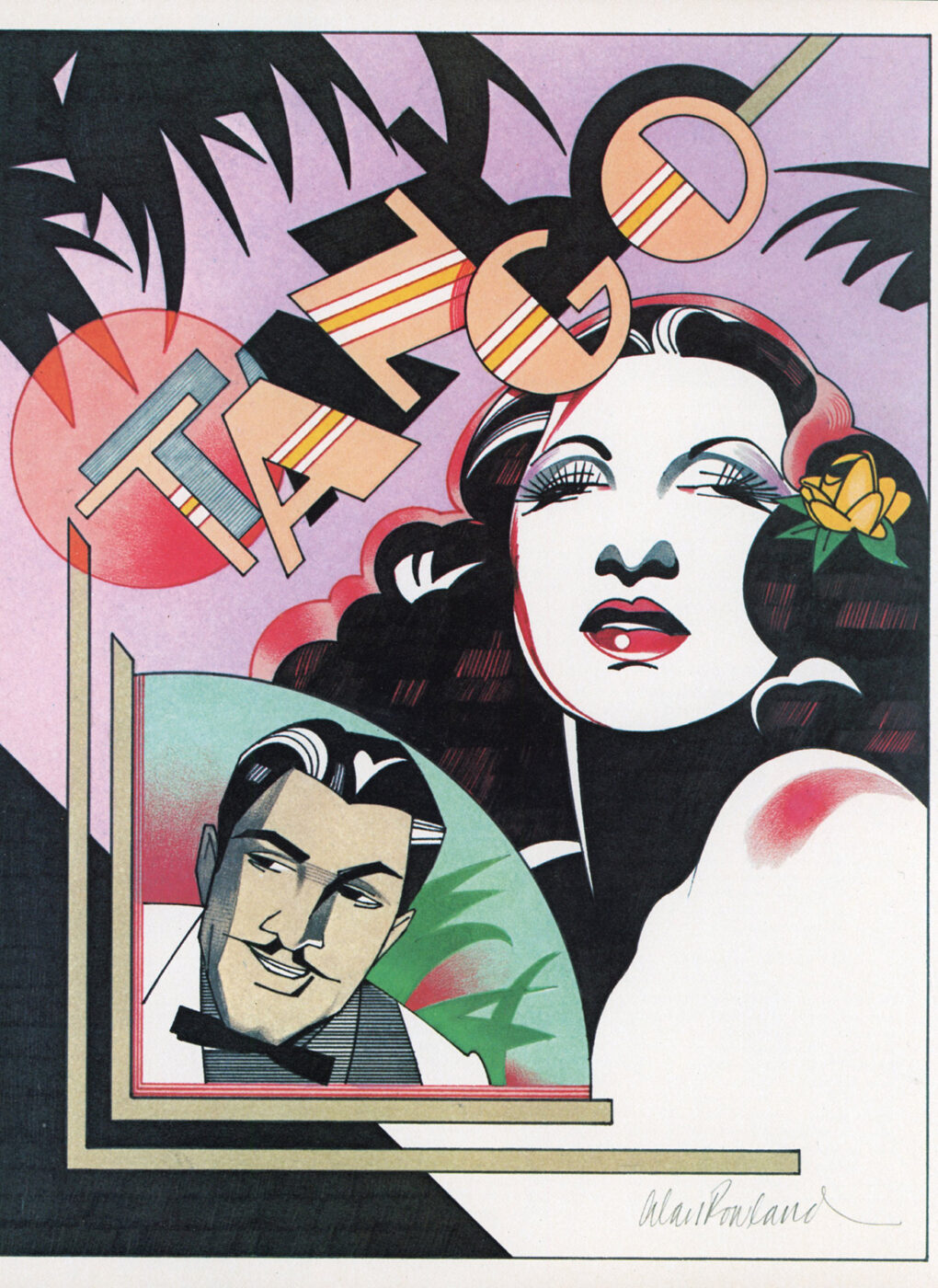
Did I tango? My whole life was tango, especially one tango. The words were the rhythm of my life, the music, the rhythm of my soul. Whenever I heard that tango, my tippi-tip toes went tappy-tap-tap to the edge of the dance floor, where, top hat, white tie and tails, I got into my best “slink” position and took to the floor like a goose to water. I had been known to do so without a partner. I had been known to do so cradling a bottle of gin.
She was still taking off her long black gloves.
“Do you tango?” I asked.
“I once won a bottle of champagne doing the tango,” she said. “But that was many years ago; another world, another age,” she trailed off wearily in an aside to the air. People talked to the air in those days before those people began to realize the air wasn’t listening.
“How many is many?” I asked, and we both answered in unison: “Too many.”
“Let me tell you the story of my life some time,” she said.
Had I seen this movie?
Three beats.
“How do they make a frozen daiquiri?” She shrugged her dripping shoulders.
“They take a daiquiri and freeze it.”
Then suddenly I heard it begin and shuddered. I froze. My heart went pitter-patter. My wrists went limp (Rita immediately noticed). I broke out in a sweat.
“Don’t tell me,” she said. “You ate them raw. Don’t you remember? Only in months with an R.”
“No, no, it’s the music. It’s my tango, they’re playing my tango. Oh if you know how much it hurts! It pains and yet it’s an exquisite pain …”
“Are you into that scene?”
I began to hum along, and my feet began to live a life of their own.
“Adios muchachos, companeros de mi vida . . .”
I was at the dance floor and Rita was in my arms. She tangoed wildly, tempestuously. Because she was doing a samba. She was still taking off her gloves.
“Life’s rotten!” I said, as we took a deep bend backward.
“War is hell!” Rita answered, as we took a deep bend forward.
We met sideways with such force we bruised our cheekbones, and the clash was like an added maraca.
“Europe is overrun . . . ”
“And overripe . . . ” Three beats. “Why can’t the orchestra keep the rhythm?”
I was too embarrassed to tell her. Instead I said, maybe foolishly, “It’s like the beat of my heart.”
“How can you talk of ‘heart’ when Europe is . . . ”
“Overripe?”
“No. Overrun.”
There was a story here. A good girl gone wrong (or a good guy become a good girl gone wrong; a story anyway). War, upheaval, surreptitious cover of night, over (or under) barbed wire, probably with nothing more than an emery board. Country to country with phony passports, escaping persecution, one step ahead of the gendarmerie; haunted and hunted and (for all I know) hounded.
She leaned close; I could sniff juicy-fruit gum on her breath. “The Nazis!” she whispered in my ear; what did she mean? “May the Third Reich endure a thousand years?” Or: “They’re after me?” Did she have a secret to tell?
“You’re German?” I asked in a whisper.
“Brazilian.”
“But . .
“I know, I know. That’s what makes it so complex . . .”
“Who’s after you, tell me!”
“You wouldn’t believe me . . . ”
“You poor kid,” I said, cupping her — bristly —chin.
“I am a Child of the Century . . . Jesus, this orchestra is from hunger. You want to hear something? They’re playing a samba to Adios Muchachos …”
“Want to hear something better? They’re playing a tango, you’re dancing a samba.”
“Nonsense! I don’t know the difference between a tango and a samba? One-two-three, one-two-three . . .”
“That’s a waltz. Are you sure you’re not a transvestite?”
Pause. “You will know when you take me in your arms,” which if she meant the euphemism I thought she meant, would be one sure way of knowing. “Where was I?” she continued.
“You were a Child of the Century . . .”
“Ah yes. War-ravaged, world-weary. Identity crisis-ed (she actually said that) and countercultured. Truly, I . . .”
“And verily . . . ”
“What?”
“I said, ‘truly and verily.’”
“Don’t make mock of what is in essence a tragic story. Oh not just my story. Your story, our story, the world’s story . . . Another frozen daiquiri . . .”
She was still pulling off her gloves.
I met Rita again when the Nazis invaded Czechoslovakia. Oh we weren’t in Czechoslovakia at the time, we were over Newark airport flying down to Rio. Oh me-o. By the sea-o. As I sat next to her I wondered, was Rita really a man? Was she maybe the first sex-change? Or was she Carmen Miranda’s double, as she said (they didn’t look anything like each other)? I hadn’t held her in my arms, rather, I had just held her in my arms, and when I kissed her lips, I had felt a little bristly growth below her nose and on her chin. Maybe the puzzle would fit itself together by the sea-o.
But, damn it, I was too curious to wait. Was she really even Brazilian? Would she remember she had told me that? As innocuously as I could, I asked, in a very casual tone, “Rita? What is your race, creed, and country of national origin?”
I studied her face. “I travel with a Lithuanian passport,” she replied enigmatically (or was it facetiously?).
She lit another black cigarette in the gold-plastic holder.
“I see you still have the same monogrammed holder,” I said.
“It’s not monogrammed. That’s the cutrate-drugstore price sticker. I forgot to remove it.”
“Darling, let’s not keep up this hollow chatter! Let’s get down to basics. You. Me. Us! Extra-verbal communication!”
“I once had this bullfighter who was madly in love with me,” she said, staring out at the clouds.
“Oh?” I said unconcerned. “What happened?”
“He went the way of all great toreros!” “Gored, you mean.”
“No, he retired to Florida. Sun City, I think it was. Everyone is over sixty, and security guards everywhere. The entire place is surrounded by a moat. Maintenance is wonderful; why he doesn’t even have to mow . . .
Excerpt from Playgirl, January 1974
. . . Keep reading on PLAYGIRL+