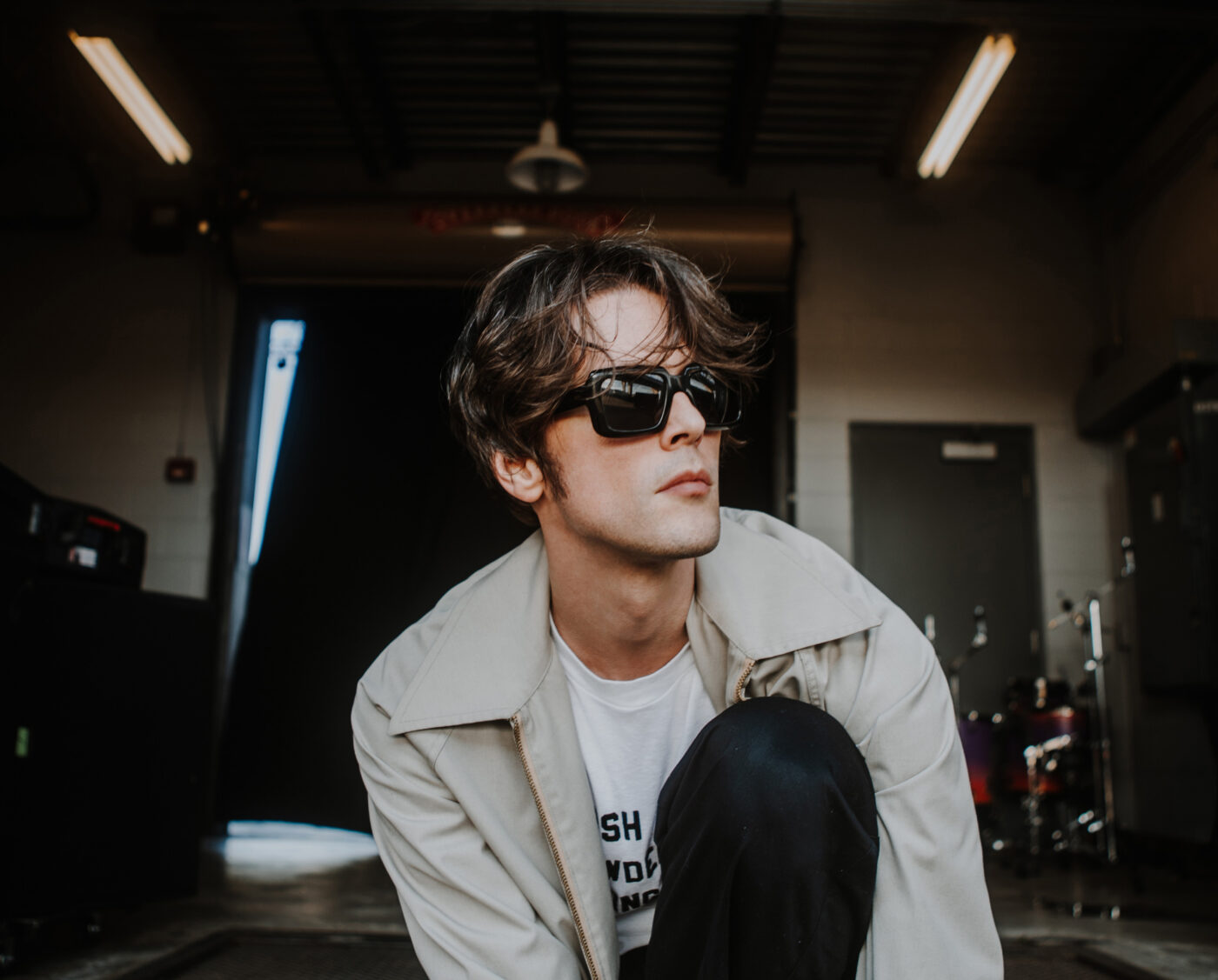
Some roles are chosen. Others are assigned before we’re old enough to question them.
Long before Dallon Weekes fronted a band, he had already learned how to inhabit expectations. Growing up Mormon in small-town Utah meant there was already a shape to the life ahead of him: missionary, husband, father. The question of whether that life actually belonged to him came later.
“It’s not a very casual faith. It asks a lot of you,” he says. “I spent way too much of my life paying lip service to that and going through the motions for the sake of family and living your life according to this plan that has been laid out for you.”
At 19, as expected, Dallon left for a two-year mission. Knowing what he knows now, he says he wouldn’t choose to do it again, though he doesn’t entirely regret it. The experience forced him to grow up quickly and introduced him to a world beyond the small Utah town where he’d been raised. It also made literal something he’d been learning since childhood: how to play a part.
“I think performance is something that’s curated very early on, especially in Mormonism,” he says. “You’re given these roles that you’re supposed to perform throughout the course of your life.” He did exactly that for a long time, until he began questioning why. “Eventually that fork in the road comes where—I would hope—each person asks themselves, ‘Why am I doing this? Is this mine, or is this something that was given to me that I’ve been carrying?’ And for me, it was the latter.”
Music, however, seems to have been his. One of his earliest memories is wanting a guitar before he even really understood what one was. His family assumed it was a phase, and even as he got older there were questions about when he’d get his “head out of the clouds,” go back to college, and find a real job. Rock and roll became more than a career ambition; it became one of the first places Dallon encountered ideas outside the world he’d been given.
As a teenager, he gravitated toward artists openly talking about homophobia, misogyny, and politics. He remembers hearing Eddie Vedder use the term “pro-choice” in an interview when he was 14 or 15, not knowing what it meant, and going to find out. “That’s how I learned about those things, through my heroes in rock and roll,” he says.
Rock and roll was becoming its own belief system, with one crucial difference: this one wasn’t prescribed. “It was one that was mine,” he says. “It wasn’t given to me, but it’s one that I discovered and had it resonate.”

Courtesy of Dallon Weekes.
The two worlds were already bleeding into each other during his mission. Dallon was supposed to abstain from secular music, but beneath the missionary name tag and tie he was secretly listening to Dead Kennedys and Operation Ivy. He doesn’t describe what followed as rebellion, though. When I ask if pursuing music felt like freedom or defiance, he reaches for a different metaphor.
“It felt more like archaeology,” he says. “Discovering yourself, uncovering it bit by bit. And, oh, here I am, and this is okay. I can be this, and it’s fine. It’s safe to be yourself here.”
Years later, learning more about his own neurodivergence gave Dallon another way of looking at that process. Over the past five or six years, he’s reconsidered just how early he learned to edit himself. He describes masking not simply as a habit, but as survival.
“If you are authentically yourself, that puts a target on you,” he says. “You become immediately perceived in ways that you can’t control, and that in your nervous system doesn’t feel safe.”
But he hadn’t learned to mask against what he calls the baseline of the “regular world.” He’d first learned to make himself legible inside Mormon culture. “I learned to mask, to operate safely on this plane of existence within Mormonism,” he says. Outside of it, he realized he’d been calibrating himself according to a different set of social expectations. “I’ve been doubly removed from the ordinary.”
He only began to understand his own neurodivergence because of his son. Wanting to better connect with him, Dallon started reading, recognized many of the traits in himself, and eventually brought a growing list to his doctor.
That knowledge also changed how he looked back at childhood. “A lot of things get covered by this veneer of perfection,” he says. “The closer you are to perfect, the closer to the Lord you are.”
And yet, the place where he found the most freedom from that constant calibration is the place where he’s ostensibly supposed to be performing. “Up onstage, that’s where it’s safe for you to be who you are,” he says. “Sometimes a version of yourself that’s turned up to 11.”
His brain is usually firing in multiple directions at once, but performing lets him exist in one moment. “It’s just the best thing that there is, to be able to walk out there and turn your brain off and to just exist in a singular moment,” he says. Onstage, performance isn’t another mask. It’s one of the few places he gets to take his off.
Offstage, being perceived proved harder. When Dallon joined Panic! at the Disco in 2009, he entered an already established machinery of celebrity and fandom with no gradual acclimation. He describes it as being dropped into the deep end of a pool without knowing how to swim.
“It’s difficult to just suddenly be perceived on a level like that and not have any control over how you’re perceived,” he says. “That’s something that I struggled with my whole life, trying to control the narrative about how people perceive you.”
Celebrity made that control virtually impossible, but it also exposed him to people and perspectives he’d never encountered before. Sometimes the education came by getting things wrong. “You need to be okay with being wrong about something,” he says. “Just being open to the possibility of being wrong and then changing for the better, hopefully.”
That willingness to be wrong runs counter to the certainty he’d grown up around. “People mistake conformity for certainty,” Dallon says.

Courtesy of Dallon Weekes.
The problem of being perceived hasn’t disappeared. Social media has only made access to artists feel more like part of the job, while Dallon remains wary of sharing unfinished work or half-formed ideas. Still, he’s trying to loosen his grip on how any of it is received.
“When you’re making art, you have to be okay with the idea that you can’t control the way that it’s perceived once it’s out into the world,” he says. “You can only control what’s made and what you share with people.”
His relationship with his wife, Breezy, offered another kind of permission. They were married before Panic!, before arenas, and before music was reliably paying the bills. Dallon credits the relationship with making the career that followed possible.
“You lean on each other, you grow together, and you check each other’s blind spots,” he says. “I definitely wouldn’t have the career that I have if I didn’t have the support of a partner who’s on the same team every step of the way.”
Then he comes back to the idea of permission. “I think the right relationship can sort of give you permission to be who you are,” he says. “And all of this pursuit of music and self-expression, chasing that permission to be who you are—I think it’s an exercise in that.”
It’s hard not to notice how many contradictions coexist in Dallon’s life: the Mormon missionary secretly listening to punk rock; the kid raised around conformity who built a career out of creative expression; the musician who makes a living being watched while resisting being perceived. The older he gets, the less those contradictions bother him.
“Those contradictions are what allow you to find the authentic version of yourself,” he says. “You have this idea of who you are, along comes a contradictory idea that resonates with you. And so those two things have to battle it out at least for a little while.”
That leads us to reinvention, another idea Dallon is skeptical of. “I think people tend to mistake aesthetics for reinvention,” he says. “A new haircut or a suit or a new era on your album, whatever. That’s the easy part.”
What interests him is harder. “The harder part of reinvention is reinventing or revisiting the systems that brought you to where you’re at,” he says. “Continuing to make something that’s still interesting after you’ve been doing it for most of your life.”
He’s about to put that into practice. Dallon is heading back into the studio, but instead of arriving with songs meticulously carved into finished form, he’s deliberately leaving room for uncertainty. His last album was written during COVID, when isolation gave him enough time to obsess over every detail. This time, he’s bringing unfinished ideas to the band and relying more on instinct.
Success inevitably brings expectations. Fans, institutions, and the industry begin to anticipate a particular thing from you, and Dallon’s instinct when that happens is admittedly to do the opposite. “I’m aware of those expectations. I’m just not concerned with them,” he says. “I want to make art that I’m proud of and that’s honest and real and things that I care about.”
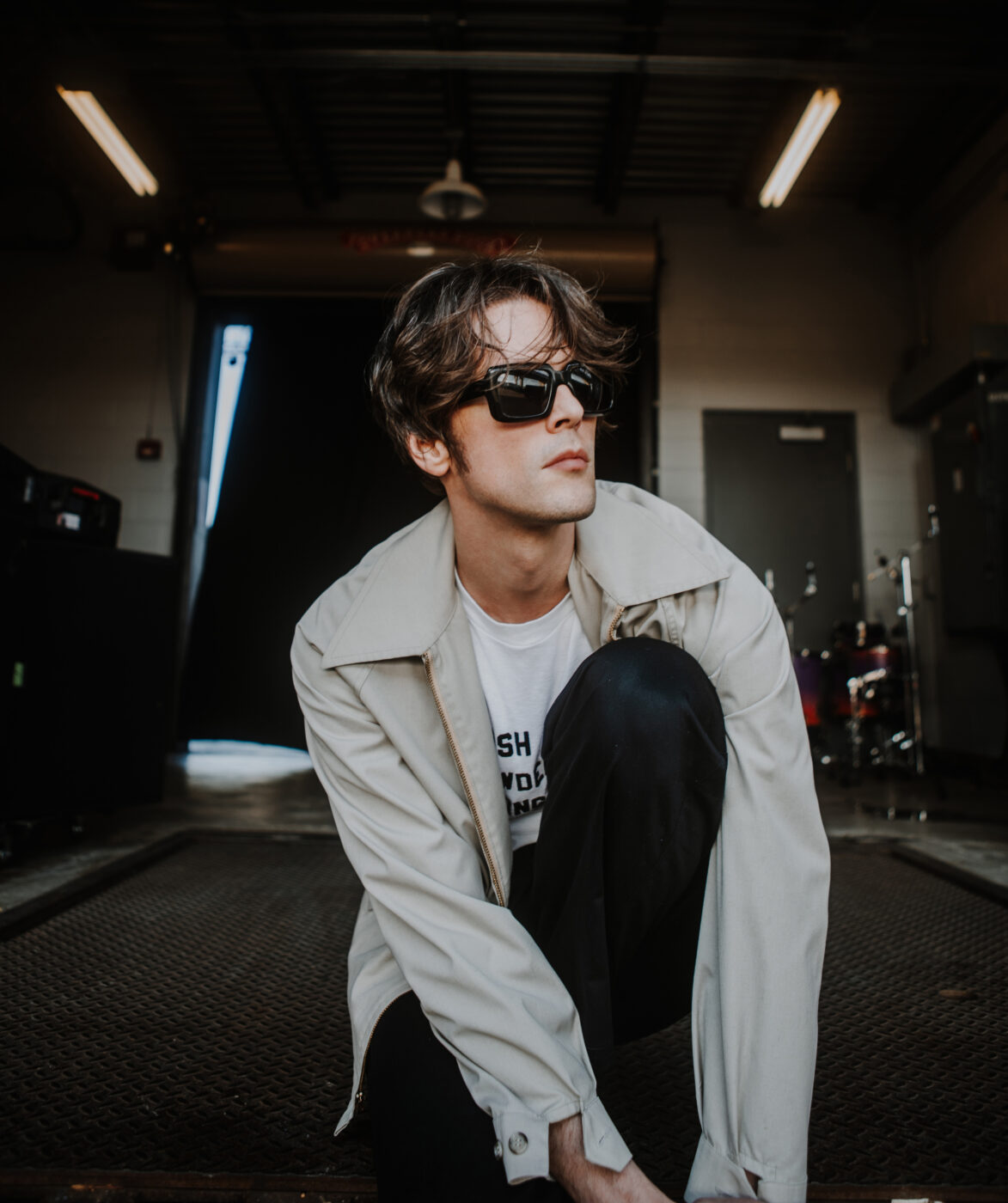
Photo: Ariel Kassulke.
He knows anything he puts into the world can be misunderstood. Sometimes he’ll write a lyric and wonder whether he should really say it, already imagining the people waiting to interpret it in a way he never intended. “What I can control is how much I care about that,” he says. “And as it turns out, I don’t care at all.”
It’s a hell of a long way from worrying about whether you’re properly playing the part.
Meanwhile, Mormonism—the world that gave Dallon some of his first roles—is having an unlikely pop-culture moment. Reality television and social media have turned it into a source of fascination, entertainment, and endless discourse. He notices it, though he cautions against treating the faith as a monolith.
“All walks of life exist within that religion, just like they do anywhere else,” he says. “Everyone’s got to find their own way, I guess. I feel like I found mine, or at least I’m trying to still find mine in relationship to it.”
He no longer considers himself a subscriber, but neither does he pretend the world that raised him can simply be cut out of who he is. “It’s part of how I was raised and how I grew up, and that shapes your identity to a degree,” he says. “I think it’s a matter of separating inherited beliefs from chosen beliefs. Eventually you get to a part where you have to examine what’s really mine and what was given to me here.”
Dallon has become more comfortable without a replacement set of answers. “You don’t owe anybody anything,” he says. “And don’t confuse other people’s certainty with wisdom. Some of the most thoughtful people are comfortable with the idea of, ‘I don’t know.'”
When I ask what he hopes someone might take away from all of this, his answer brings us back to the question hanging around since those first assigned roles: what belongs to us, and what was simply handed to us?
“I think maybe we underestimate how much of adulthood is separating inherited beliefs from chosen beliefs,” Dallon says. “And I don’t think we ever really fully escape our past. Even if you intentionally break away from it, it still informs who you are now. But examining it can help you decide what continues with you and what ends with you.”