“I am a human being. Nothing human can be alien to me.” Terence (Terentius Ater), the Roman playwright, an African ex-slave, 150 B.C.
I read that statement in my teens and repeated it so often that it became a litany. Against all odds and society’s evidence, I was convinced of its truth. I was six feet tall in a world of five-feet-six boys. I was Black in a community of whites. My features and figure did not conform in the least with the prevailing concept of beauty, and I wore cotton dresses in a school where cashmere sweaters, pleated woolen skirts, and white buckskins were the orders of fashion.
It was imperative, if I was going to survive at all, to know that although I might seem alien to my surroundings, I was a human being, and nothing human could be alien to me.
When at sixteen I had a child, no husband, and the urgency of finding work, I got a job as a main cook in a Creole restaurant. I had never cooked ordinary food, much less the exotic dishes of Louisiana. But some human beings created those menus, and others ate the concoctions, so I knew that my only chore as a human being was to learn the craft.
Since those days, many dark and light years ago, I have stripped paint from cars by hand, worked as a saleswoman in stores, sung in nightclubs, worked in fast-food restaurants, danced, choreographed ballets, lectured, written books, and directed movies, and as far as I am concerned, I am just beginning to meet the challenges of life. All things human are available to me. I can reject that which is dangerous and use that which encourages me to mold my own life.
I believe that every human being, born without actual mental defect, is multitalented. The chore of finding and developing the gifts varies with the person’s environment and exposure. Naturally, a child born into a family of musicians finds music in the air it breathes. Such a child thinks in musical notes, words and phrases, for that is what it hears. Scientists’ children accept the reality of science, and theologians, bricklayers, hoteliers and waitresses have offspring who are familiar (whether they are attracted to it or not) with the terms and facts of their parents’ work.
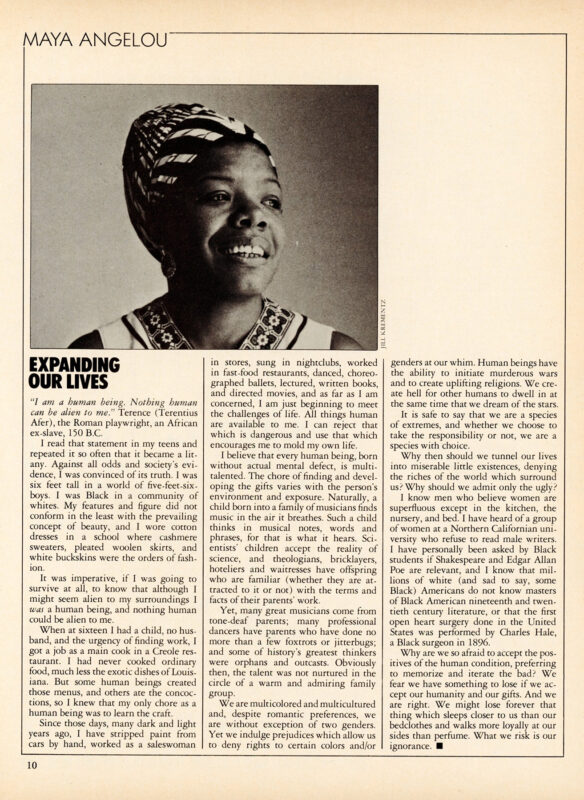
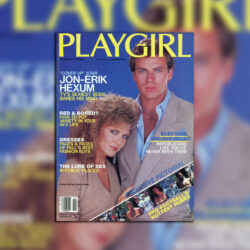
Playgirl • May 1976.
Yet, many great musicians come from tone-deaf parents; many professional dancers have parents who have done no more than a few foxtrots or jitterbugs; and some of history’s greatest thinkers were orphans and outcasts. Obviously then, the talent was not nurtured in the circle of a warm and admiring family group.
We are multicolored and multicultured and, despite romantic preferences, we are without exception of two genders. Yet we indulge prejudices which allow us to deny rights to certain colors and/or genders at our whim. Human beings have the ability to initiate murderous wars and to create uplifting religions. We create hell for other humans to dwell in at the same time that we dream of the stars.
It is safe to say that we are a species of extremes, and whether we choose to take the responsibility or not, we are a species with choice.
Why then should we tunnel our lives into miserable little existences, denying the riches of the world which surround us? Why should we admit only the ugly?
I know men who believe women are superfluous except in the kitchen, the nursery, and bed. I have heard of a group of women at a Northern Californian university who refuse to read male writers. I have personally been asked by Black students if Shakespeare and Edgar Allan Poe are relevant, and I know that millions of white (and sad to say, some Black) Americans do not know masters of Black American nineteenth and twentieth century literature, or that the first open heart surgery done in the United States was performed by Charles Hale, a Black surgeon in 1896.
Why are we so afraid to accept the positives of the human condition, preferring to memorize and iterate the bad? We fear we have something to lose if we accept our humanity and our gifts. And we are right. We might lose forever that thing which sleeps closer to us than our bedclothes and walks more loyally at our sides than perfume. What we risk is our ignorance.