

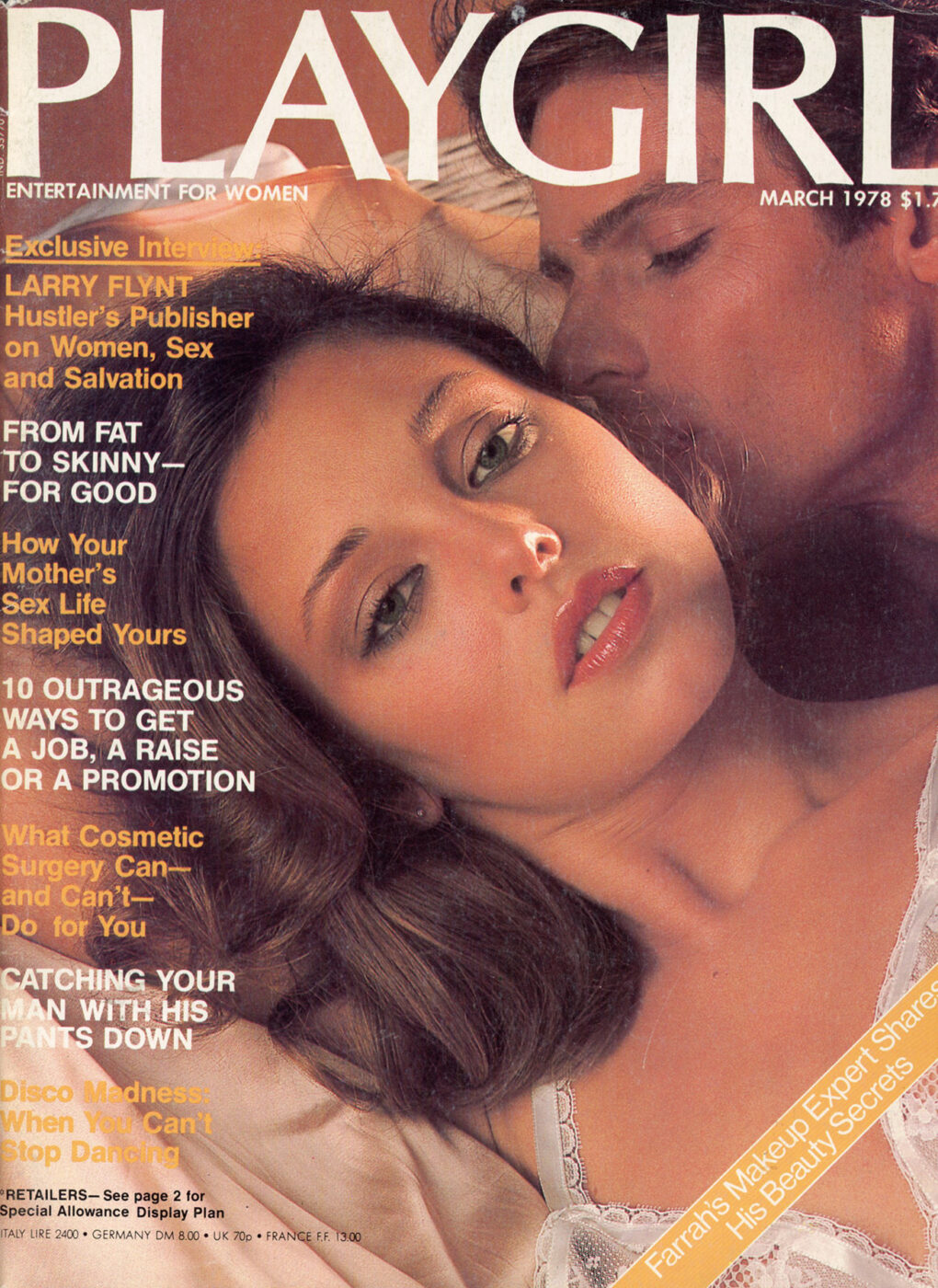
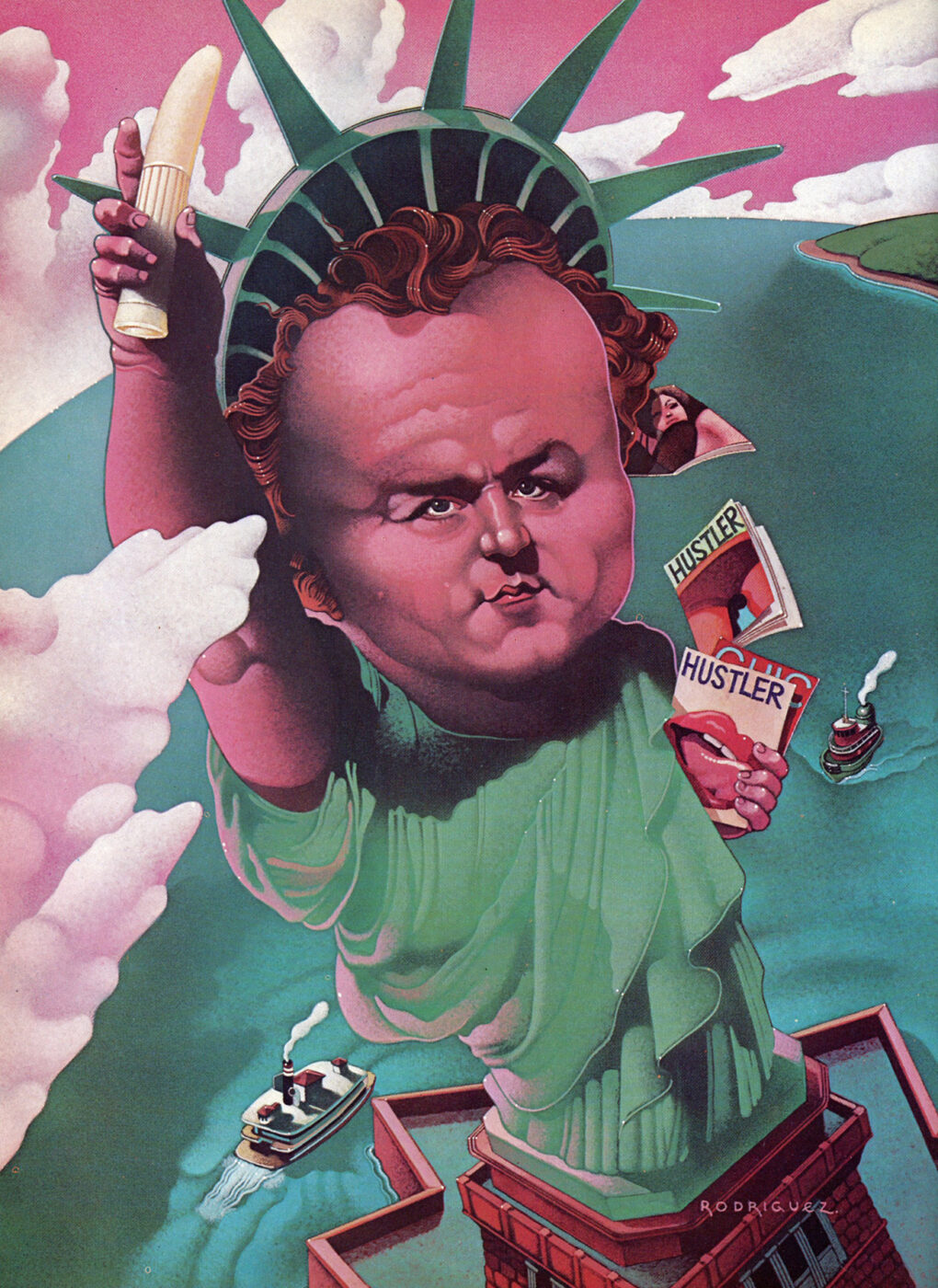
The King of Pornography found God one Sunday last November in an airplane over Texas with Jimmy Carter’s sister al his side. That same day in Jerusalem Anwar Sadat was speaking of peace to the Parliament of Israel, a nation with which Egypt was technically at war. Both moves were dramatic and apparently sudden conversions. But if Sadat’s historic overtures to Israel had considerably more international meaning, Larry Flynt’s emergence as a born-again Christian was the more unlikely of two very unlikely events.
Flynt had put together a small personal empire by publishing a magazine with anything but Christian content. Hustler always sought—and always found—the lowest imaginable taste (typical photo spreads showed steaming turds, genitals bathed in vomit, an eight-and-a-half-month-pregnant, nude model). Its de facto trademark was the vagina—magnified, detailed beyond gynecological imagination, almost always in full color. There was something to offend anybody with the capacity to be offended. And women could take special offense. Flynt and his editors apparently believed the ideal woman was to be found on her hands and knees tied up.
Although Hustler had its drawbacks (Flynt has been in and out of court for two years), the raunch formula paid off. Four years ago, Flynt was taking in a hundred thousand dollars a year as the owner of a chain of Hustler nightclubs in Ohio. His ambition was to open up Hustler clubs from coast to coast. Instead, he turned the nightclub newsletter, which featured “beaver shots” of club waitresses, into Hustler magazine— and an estimated 1977 profit of $20,000,000. Besides Hustler, Flynt put out Chic (newer, glossier, less interested in excrement), ran a booming mail order business for sexual devices promoted in his magazines, and added to his personal assets. The assets included a Rolls-Royce for his fourth wife, Althea, a chauffeured replica of Jimmy Carter’s Lincoln Continental limousine for himself, a mansion in Columbus, Ohio, and an Israeli-made personal jet painted pink.
As a child in McLaughlin County in eastern Kentucky, Flynt lived through the kind of poverty that makes the idealized deprivation on Walton’s Mountain seem plush. The log cabin he grew up in had a dirt floor; he slept on a mattress made of dried corn shuckings sewn between two bed sheets; there was no electricity, only kerosene lamps; school was the proverbial one-room schoolhouse, grades one through eight.
“I can remember going to school hungry,” Flynt says. “One year my father sold the tobacco crop and drank up all the money before he got back home. And I remember being woken up in the middle of the night hearing my mother crying, ‘What are we going to do? How are we going to eat for another year?’”
Flynt’s first step out came at fourteen when he persuaded the well-connected mother of a friend to forge a birth certificate to get him into the Army. By sixteen he was on his own, washing dishes, driving a tractor, selling encyclopedias and then Bibles door-to-door. By the time he was twenty-one, he had been married twice and had declared bankruptcy twice.
Flynt believes that Hustler grew from an amateurish newsletter to the third largest (after Playboy and Penthouse) men’s skin magazine because his experience allows him to identify with the audience he wants to reach (factory workers, truck drivers, beer drinkers, rednecks—real people). “Hustler is a mirror of society,” Flynt would repeat before he was “born again.” “The world today is very offensive. I’m just a reflection of what’s happening.”
Flynt’s reluctance to act as what he describes as “a censor for my readers” made him a prime target for district attorneys looking for obscenity convictions. In Cincinnati, a conviction on obscenity and “organized crime ” (he “conspired” with a magazine distributor and his co-publisher, among others, to sell Hustler) could get him a twenty five year sentence. The case is on appeal. Two similar cases are pending in separate counties in the Atlanta area, where he faces trial on twenty counts altogether, each of which carries a sentence of one year.
After Flynt was convicted in Cincinnati, Playboy printed a grudging defense: “He [ Flynt] is trying to wrap his garbage in the Bill of Rights, but the Cincinnati court is trying to turn the Bill of Rights into garbage.” When Playgirl’s editor Barbara Cady talked with Flynt before he was “born again,” she found him anxious to talk about the state of the First Amendment and what he is or isn’t going to do to it, or with it.
“Larry Flynt was wearing red nylon pajamas and lounging on a couch when I met him for our first interview in his bungalow at the Beverly Hills Hotel,” Cady reports. “As always, his bodyguards were there, occasionally interrupting the conversation to bring us coffee or deliver messages. He talked freely and matter of factly about every topic I raised: his early life, his publications and the nature of sexuality—including specific details about his own.”
“Flynt spoke in a soft voice and with a politeness that reflects his rural upbringing. But whenever the issue of freedom of the press and what he sees as the public’s apathy toward it came up, he became more and more animated, almost angry. Clearly the publisher of Hustler had found something besides ‘beaver shots’ to get excited about.”
By the time Cady spoke to Flynt again, he had found something else to get excited about. Jesus. If the story of the early Flynt was Horatio Alger, the new Flynt was Hollywood from the era of The Bells of Saint Mary’s.
“When I talked to Larry Flynt, I wasn’t particularly interested in a theological discussion,” Cady said. “’The Christian God is real,’ he told me, but that argument has gone on for two thousand years. I wasn’t about to tangle with someone who’d just been saved. What I wanted to know was, ‘Is Larry Flynt real?’”
What follows is Cady’s two-part interview.
Before you came on the scene, there were already a host of skin magazines for men—Playboy, Penthouse, et cetera. Why did you start Hustler?
I wanted to deal with sex the way I knew it growing up. I’ve served in both the Army and the Navy, I’ve worked in factories, washed dishes, sold encyclopedias and Bibles, and I wanted to deal with sex in a very unpretentious way. I wanted to bring it out of the locker room and write about it the way my friend on the street talked about it —four letter words and all.
Are you suggesting that Playboy and Penthouse don’t present a true picture of male sexuality?
Well, you know, like Hefner says, with Playboy they sell the sizzle— not the steak. Hefner is very great at creating fantasies and parading his pornography as art. With Hustler, I’ve always admitted that I deal with pornography.
You’ve certainly got the critics—and the indictments—to prove it.
But wait a minute now. All of the sexual fantasies and fetishes that fill the pages of Hustler are done from more of a reporting point of view than an advocating one. And there is a big difference. When you pick up a copy of Playboy, it’s obvious that Hefner likes blondes and big boobs. You pick up a copy of Penthouse, it’s obvious that Guccione is a crotch man and likes brunettes. You pick up a copy of Hustler, and you don’t really know what I am. That’s because I fight to keep my own sexual preferences out of Hustler. I accept the reality that the sexual appetite varies so much that I may not be on a parallel with other individuals. So, we publish photographs of brunettes, redheads, blondes, skinny girls, fat girls, old girls, young girls, because we want to respond to the reader for what he is—not for what we think he is.
It’s not a pretty picture.
Maybe not, but it’s real. Look, I’m not advocating orgies in the street, pedophilia, incest or any of these taboos. But I am advocating a better understanding of human sexuality. You know, most adults know more about changing a flat tire than they do about fucking. And I haven’t made woman the sex symbol she is, society has. It’s not a question of why Larry Flynt publishes the magazines he does but why millions of people find something of interest in them. Why are males fascinated with the female genitalia? It’s very simple. It’s the ultimate turn-on for the heterosexual male, and that’s eighty-five percent of our readership. The vagina is today what the ankle was thirty years ago, and I don’t think that we’re ever going to be free and eliminate a lot of the neuroses that we have until we become at ease with our bodies. I think the time will come when a man will get just as turned on seeing a woman fully dressed as he does now with her clothes off. But meanwhile, as long as there is an ear lobe covered up, somebody is going to want to photograph it uncovered.
But we’re not talking about car lobes. In addition to its standard fare of flaring female genitalia, Hustler has published pictures of a woman smoking a cigarette with her genital muscles and of women being brutalized by men. Many people find such material disgusting and, to put it mildly, degrading to women.
But if I took everything out of Hustler that was discriminatory or offensive to one sex—or one race—I would eliminate the whole magazine. Hustler is a statement of its time, a statement about the society that we live in, which is very ugly. It’s not pretty. Hustler is offensive to the majority of people, even to some of the regular readers— because it’s real, because it forces people to look at reality. Most people would prefer to live in a fantasy world.
I think such an argument would be of small consolation to the female—and male—critics who argue that Hustler‘s depiction of women only perpetuates that ugly reality you just mentioned.
But I’m getting blamed for every social ill embodied by society, and I’ve only been around three years publishing Hustler. Society has been around two hundred! So, if you want to get rid of Hustler and magazines like it because of the attitude that it portrays about women or the way it reflects women, then you have to get rid of society’s problems. And the only way we are going to solve these problems is to first accept the reality that they exist. Once you bring a taboo out in the open—which is exactly what Hustler does time and again—it ceases to be a taboo.
Now, I am not leading up to a situation where I am going to try to say that the means will be justified by the end. But there is no doubt that Hustler and magazines like it have forced us to come to grips with various aspects of our sexuality, as well as to acknowledge the important factor that the female is extremely discriminated against and that both sexes are very much lacking in education. Now, I am not going to try to talk about all of Hustler’ s educational value, but, again, my magazine is offensive because it forces people to deal with reality. And that reality is often unpleasant.
It’s not just that reality is unpleasant. Many of your critics maintain that Hustler‘s depiction of violence against women is a condonation of such behavior and, therefore, encourages even more anti-female violence.
Well, most people don’t act out their fantasies, but even if they do, it’s because they were always there anyway. That’s why the media gets a lot of criticism about over-publicizing hijackers; they say that what it’s doing is perpetuating the problem. But anyone who goes out and hijacks a plane is already entertaining that type of antisocial behavior anyway.
Perhaps. But Hustler published an article recently by Dr. James Prescott of HEW which linked child abuse with sexual repression. Dr. Prescott also sees a connection between violence on television and the tremendous increase of violent behavior in society. Wouldn’t there also be, therefore, the same carryover effect between the rape and sadomasochistic fantasies presented in Hustler and an increase in violence toward women?
To a certain degree, I happen to agree with both you and Dr. Prescott. But there is also no doubt that the violence television bombards our living rooms with is, as he himself says, even more harmful than Hustler or magazines like it, because he says we are more affected by a film—as far as psychological impact—than we are by magazines. And all of the data show that people are more apt to imitate violent behavior than sexual behavior.
But while magazines like Hustler deal with certain types of behavior that really may contribute more to the problem—even if it doesn’t cause people to go out and do it—in the sense that it’s a statement condoning certain overt acts of violence toward women, you have to stop and say, “Wait a minute!” Tell television to shut down completely? Shut down all of the magazines? Because Dr. Prescott also feels that many of the other magazines that don’t deal with pornography—like many of these detective books that describe violent rapes and murders in all their gory detail—are much more harmful than the mild bondage that many sophisticated men’s magazines deal in. So, what you are saying is that there is something wrong with society all over.
But do you think that pornography is harmful?
No, but people have mixed feeling about this. Now I know I constantly refer in public to the Presidential commission’s report on obscenity, but that was the largest task force of social scientists ever assembled to study the effects of pornography on society. And they concluded after a very trying eighteen-month investigation that exposure to even hardcore pornography doesn’t alter one’s sexual desires or create any antisocial behavior.
You know, I don’t think that children should—or even adults for that matter—smoke or drink liquor. I don’t even think children should drive cars. But we don’t suppress these vices because they may fall into the hands of children. We just restrict their sale, which I’m not opposed to. But if we tried to take everything out of society that is harmful, we would have nothing left. We are all neurotics responding to a neurotic environment. The top criteria, you know, for a successful television series in Hollywood now is to find a group of neurotic writers. So, what we’re really seeing on television is an extension of the neuroses of the creators of the shows themselves. And their neurotic behavior can all be traced back to their childhood environment.
What you’re saying sounds like Catch-22.
I don’t want to make this sound like it’s hopeless, that the quality of life cannot be improved, but it has to be an educational process. We have to rehabilitate society.
At the risk of sounding like a broken record, do we do this by printing pictures of men beating up on women?
It might take that to desensitize people to violence. And that’s exactly what Hustler does—desensitize people to aberrant sexuality. By doing this, we are educating people, making them aware that other sexual unorthodoxies exist. We are presenting the whole scope of human sexuality, so that in becoming aware of diversifications, we are able to understand our own bodies more, to reassess our own attitudes and values about the concept of obscenity and pornography and how it should fit into our lives. I have confidence that the American people can read anything they want to without being corrupted.
Are you affected personally by anything you print?
I have absolutely no interest myself in pornography. As a matter of fact, I find it extremely boring, and this is what happens after you have been exposed to it for a long period of time. I mean, people need to see the various types of pornography so they can realize that it’s not going to rot their lungs, make their hair fall out or give them bad breath. And this education is more important than the few people who are going to imitate what is on Hustler’s pages…
…Keep reading on PLAYGIRL+