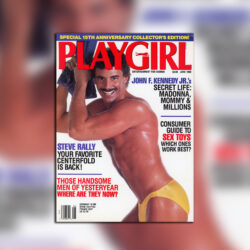

Excerpt from Playgirl, March 1985. I do not feel prepared to accept the responsibility for what George might do to himself and others if he remains on these premises —Letter from Peter Dawson, principal of Eltham Green School in London, to Boy George’s parents. At 15, Boy George was expelled from school. He was, by his own admission, the nastiest, most argumentative and most unpleasant teenager imaginable.
Today, eight years later, he is a pop culture phenomenon. As the centerpiece of the rockreggae-disco Culture Club, Boy George has created music that is melodic, piquant and overwhelmingly commercial. The band’s first U.S. album, Kissing to be Clever, sold about 5 million copies worldwide, and the single “Do You Really Want to Hurt Me?” reached number one in 51 of the 52 countries where it was released. The follow-up Colour By Numbers album did about twice the business, selling between 9 and 10 million copies. The band’s third album, Waking Up With the House on Fire, was released in late October.
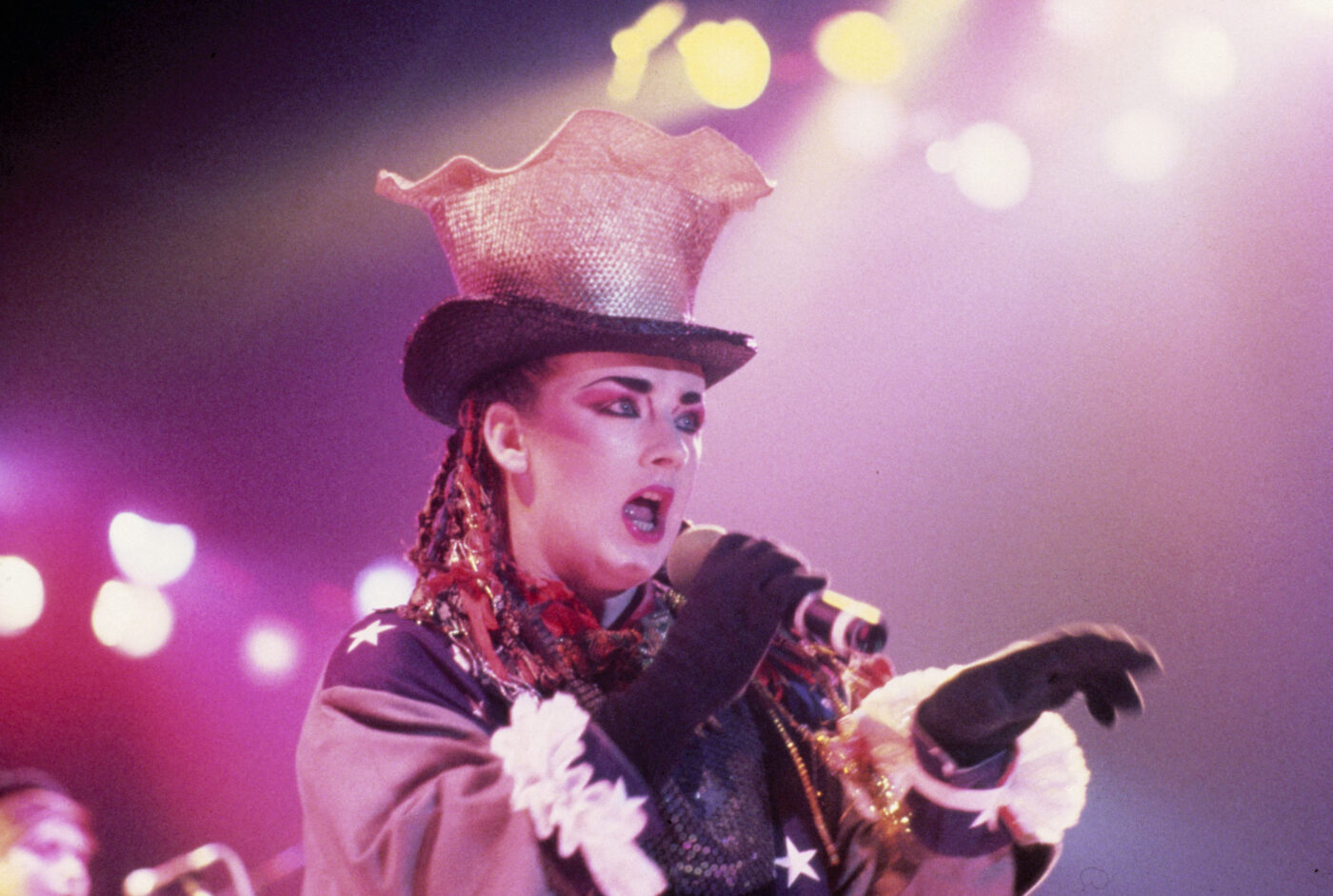
There is no question that the Boy has talent. But surely an equal part of his appeal derives from his astonishing appearance. Billowing robes and multicolored carnival clothes, a rainbow of hair colors (the new style, replacing long plaits), the Japanese-white skin and perfectly penciled ruby lips: Boy George takes conventional notions about gender and snaps them in half over his knee.
On the surface, this character is pure playfulness. He is threatening only to those without a sense of humor, and to those who would staunchly deny any similarity between the sexes. Note: This is not Prince, who beats the drum for salvation through sex; nor is it David Bowie, with his dangerously decadent androgynous pose; nor is it Grace Jones, with all her ferocious, male-female animal energy.
“I am likable. Most people would rather sleep with a teddy bear than an action man.” “I’m a poof with muscles.” “I’ve never not done one or the other”— Boy George’s comments on sex are cause for a laugh, not serious for a cause. His fans include young children and senior citizens; his female counterpart is the kitschy Cyndi Lauper.
Yet there is another Boy George story. It is not a particularly delightful one. It involves anger, violence and poverty, confusion, rebellion and rejection. It might have ended in a thousand other, much less happy ways, and it reached a crisis point with that note written by the high school principal to Jeremiah and Diana O’Dowd, George’s parents.
Today, Eltham principal Peter Dawson comments: “There was nothing more the school could do for George. He was bright, intelligent, but a total misfit. He did not fit in. He just did not want to be part of it in any way.
“For a while we put him in a special unit— called the Glasshouse, at the top of the school—with a psychologist to help, but it did not work. He just sat and looked at the wall and doodled all day. Anyone who can express their rebellion by sitting and looking at a wall from nine till four is definitely not an ordinary person. It was certainly the best for us and probably, in the light of subsequent events, the best thing for him, that he went.”
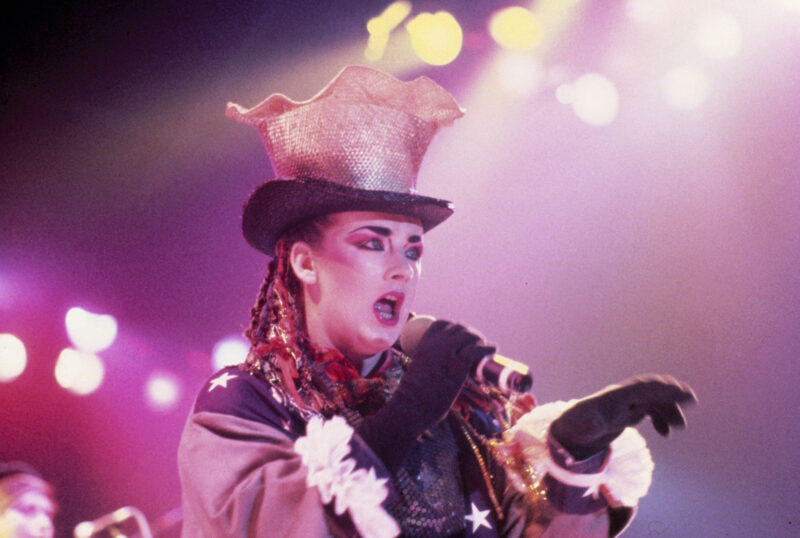
Boy George • Photo: Pictorial Press/Alamy.
The precipitate cause of George’s expulsion was the fact that he showed up one day wearing dyed-orange hair, white sandals and pegged pants. The underlying attitude, though, had taken root years before, and was fortified through verbal and physical combat at home. George was the third child among six, with four brothers and one sister. His father, Jerry, was a construction worker and an amateur boxing coach.
“My father had a lot of problems by the time I came along,” admits George, sitting in his parents’ modest, tidy three-bedroom house in Eltham, where his gold records are displayed along with his brothers’ boxing trophies. “He didn’t have any money, he’d left the army, and he had all these bloody kids. He was a builder and had a hard time until his business started to do well. With six of us, my parents didn’t show any emotion at all towards me. And all the time that was what I wanted. I wanted to kiss my father. I wanted affection, but he used to come home and take his aggression out on us. I hated him then. Sometimes my dad would tell me to fetch something and I’d say, ‘Get it yourself.’ And he would go mad and chase me up the road. Then I’d say, ‘After all the trouble you’ve taken chasing me, you could have done it yourself.’ He was violent’—but basically he’s very lovely. I do love him now, but then, he just didn’t know when to stop.”
Jerry O’Dowd recalls his own motivations: “I never wanted to hurt him. The truth is that when he was little, the other children would sometimes bully him and he would let them get away with it. He wouldn’t do anything about it. He’d just cry a bit and walk away.”
In vain, Jerry tried to “make a man” of his son—sometimes on the end of a right jab. “Even when he was tiny, George was a pacifist,” Jerry recalls. “However, I tried to toughen him up, to make him stand up for himself. But he resisted. For a long time, he believed I did it because I wanted to hurt him. It was so hard to explain all that to him then. I know I was not as gentle as perhaps I should have been.”
But the anger and aggression were not all one-sided. Boy George admits: “I was terrible. I used to hound my mother. Once she threw the toaster at me. She would shout: ‘Get out! Get out!’ And I’d shout: I hate you!’ She’d shout: ‘Wait till your father gets in.’ And I’d swear at her and call her a bitch and go up in the road thinking I would get killed for shouting at her.”
At 14, he ran away from home following a fight with his father. “I thought, ‘Right, I don’t want you to love me. I don’t want any affection from you at all.’ We had this massive fight and I locked myself in the bathroom. He smashed the door down and I tripped and cut myself. By the time he had smashed his way through the door, he no longer wanted to kill me.” He stayed with a friend for a fortnight, returning to his parents’ house because that was still the only home he had.
Around this time, the confused teenager began to experiment with his appearance. There was a fifties teddy boy phase with greased-back hair, an orange-haired Bowie homage, and a finger-in-the-light-socket punk look. His clothing ranged from flares to drainpipe pants to caftans; accessories included platform shoes, bright scarves and extravagant splashes of makeup.
Jerry’s response was utter consternation: “I’d been in the army, and I could not understand a boy of mine wanting to do that. But I thought it was just a phase he would go through. There is room for all kinds of people in the world, and after all, it doesn’t hurt anyone, does it?”
… Keep reading on PLAYGIRL+