“Does size matter?” asks Susan Bordo in her book The Male Body: A New Look at Men in Public and in Private. Her answer is immediate and disarmingly direct: “Absolutely, yes.” Yet she quickly complicates the question, insisting that size is never merely anatomical. It is never just a matter of nerve endings tickled inside women by an extra-large cock, she argues, but always a collaboration with the imagination — and therefore with culture.
Across civilizations, the oversized phallus has been worshipped, ridiculed, racialized, censored, sculpted, commodified, and mythologized. It has symbolized power, excess, and vulgarity, dominance and humiliation. To trace this long and curious history, we spoke with Professor Emeritus Laurence Senelick of Tufts University. He has lectured on “The Rise and Fall of the Penis” in theatrical contexts at an international conference called The Flesh Made Text. He has published about clandestine and pornographic theatres of 18th-century France — where participants were referred to as “sexual athletes” because of their “gymnastics” rather than as actors — and he is someone who dares to rush in where other academics fear to tread, often afraid of smudging their reputations. In short, he’s one of my personal heroes.
Fertility, Dionysus, and Greek Ideals
We sat down with Mr. Senelick in Boston and asked him how far back one needs to go when discussing a cultural fascination with large penises and what might be called “big dick energy.”
“It all starts with fertility,” he says. “The Egyptians and the Hindus, for instance, erected huge phalloi as totems. The Greeks were somewhat different. The cult of Dionysus held that the god had been born with a deformity — an oversized penis, which delighted women and made him hated by men.”
Since classical Greek culture was pederastic, the physical ideal was the male adolescent, whose penis had to be in proportion. In the gymnasium, athletes worked out nude, so they bound up their genitals with nets. In Athenian vase painting, nude male figures tend to be standardized: handsome, slender, and well-muscled. For the most part, the penis is small, for the Athenians were not “size queens.” Large genitals are characteristic of manual laborers, dwarves and pygmies, decrepit old men, and foreigners.
“When upper-class Athenian men are shown to be heavily endowed, it is within the context of loss of self-control,” says Senelick. “Blasphemers or drunken carousers are depicted flouting the doctrine of ‘nothing in excess.’ Their penises are delineated as outsized because they are behaving like aliens.”
Susan Bordo echoes this, writing that human cultures have been somewhat ambivalent about very large penises. “Like very large breasts, they are often viewed as gross and a sign that there is nothing much ‘upstairs’ (the body’s endowment being seen as hydraulically regulated; what accumulates at one end has been forced out the other).”
Romans, Locker Rooms, and Male Insecurity
Moving on to the Roman Empire, Senelick remarks that the ancient Romans, “like the Americans,” liked things big and powerful. In a satire by the 2nd-century Roman poet Marcus Valerius Martialis, known as Martial, we read: “If from the baths you hear a round of applause, Maron’s giant prick is bound to be the cause.” This points to a phenomenon: those most interested in dick size and measuring up are other men. This is often referred to as “shower syndrome” or “locker-room phobia.” Men are haunted by the humiliation of being “too small,” especially in cultures where the phallus is seen as the patriarch’s sword and scepter, a symbol of supposedly natural male dominance.
This results in considerable insecurity. Men tend to underestimate their penis size, no matter their actual dimensions, writes Bordo in her chapter “Does Size Matter?” Even with average-size penises, men tend to see themselves as too small. Average size is currently defined by doctors as four inches non-erect and six inches erect. Professor Alfred Kinsey was probably the most prolific penis measurer in history, collecting statistics from 2,500 men for his 1948 groundbreaking book Sexual Behavior in the Human Male. From his research, Kinsey concluded that 65.7 percent of all erect penises are between 5.5 and 6.5 inches; he found none measuring more than nine inches. This brings to mind a joke Bordo tells in her book: “Q: Why are women such bad mathematicians? A: Because for years they’ve been told that this [thumb and forefinger a few inches apart] is eight inches.”
Biologist Jared Diamond argues that women tend to report that the sight of a penis is, if anything, unattractive. The ones really fascinated by the penis and its dimensions are men. “In the showers, in the locker rooms, men routinely size up each other’s endowment.” Jacques Peretti, producer of the documentary The Perfect Penis, claims there is an “underlying gayness to the male preoccupation with cock size.” Dian Hanson, editor of the international bestseller The Big Penis Book, a voluptuous Taschen coffee table book, writes in her introduction: “The best advice for the man obsessed with penis size or perceived lack thereof is less envy, more admiration.”
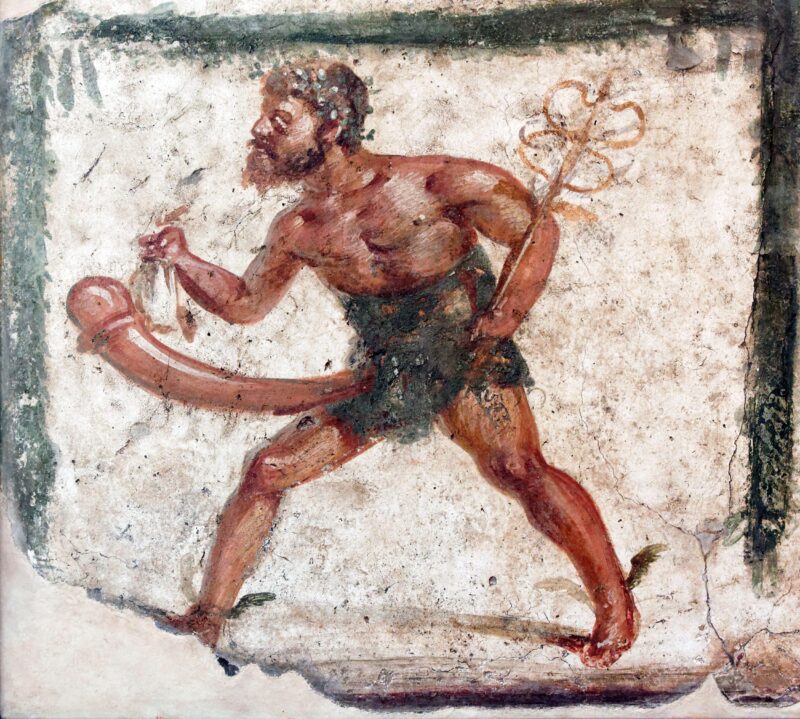
Roman fresco found in Pompeii • 1st century AD • Museo Archeologico Nazionale, Naples.
Flaccid, Limp, and the Power of the Gaze
“Conversely, flabby parsnip-like dicks are mocked in Catullus, the late Roman Republic poet,” continues Senelick. Richard Dyer, a British cultural theorist, writes in his essay Don’t Look Now: The Instabilities of the Male Pin-Up: “The limp penis can never match up to the mystique that has kept it hidden from view for the last couple of centuries, and even the erect penis often looks awkward, stuck onto the man’s body as if it is not part of him.”
But is such a stuck-on spectacle something that deserves to be stared at, by women who enjoy marveling at size, comparing (and dismissing) men according to their dimensions? Dyer writes: “The idea of looking as power and being looked at as powerless overlaps with ideas of activity/passivity.”
“One of the things I really envy about men,” a friend once said to Dyer, “is the right to look.” She pointed out how, in public places — on the street, at meetings — men could look freely at women, but women could only look back surreptitiously, against the grain of their upbringing. As Dyer notes, there is no doubt that the image of the phallus as power is widespread to the point of near-universality — from tribal and early Greek fertility symbols to the language of pornography, where the penis is endlessly described as a weapon, a tool, a source of terrifying power.
Yet today, women enjoy buying “big dick” art and hanging it in their offices or living rooms as a sign of emancipation and celebration of their own lust of looking, as New York art consultant Thomas Knapp noted in an interview with me a few years ago. “More and more women are joining the field: women who are CEOs with enough money to invest in art. They buy art for themselves, and what they choose is different.” Or emancipated, doing exactly what men have been doing with female nudes for centuries? Just as a reminder, the raison d’être of a magazine such as PLAYGIRL, designed for women, has been exactly this as well: an emancipation of female lust, with a power twist. And the fact that gay men liked it too, from the beginning, doesn’t change that narrative.
Christianity and the Repression of Male Sexuality
Once Christianity takes over, discussions of dick size take a back seat. “The earliest depictions of Jesus make him resemble Dionysus (but clothed),” explains Senelick. “But as Christian sects grew more ascetic, Christ was played down as a sexual being.” Leo Steinberg’s The Sexuality of Christ in Renaissance Art and in Modern Oblivion points out that when the Crucifixion became a standard motif in painting and sculpture, it became important to reject anything that might suggest erotic appeal. Nevertheless, in certain paintings, the cloth covering Christ’s groin seems to reveal tumescence.
Michelangelo’s Risen Christ (1514/1520), totally nude and equipped with a full set of genitals, was taken to be so reprehensible that an apron was affixed to every copy. “The Counter-Reformation initiated the practice of covering artistic renditions of male genitals with fig leaves,” says Senelick. (The official tasked with this in the Vatican was nicknamed “Il Braghettone” — the Codpiece.) Note, however, that Michelangelo does not emphasize the dimensions of the penis in his work. The penis of Adam on the Sistine Chapel ceiling has even been described by a French critic as “derisory.” The penis, as a natural feature of the male anatomy, had to be included — but it was not to be made dominant.
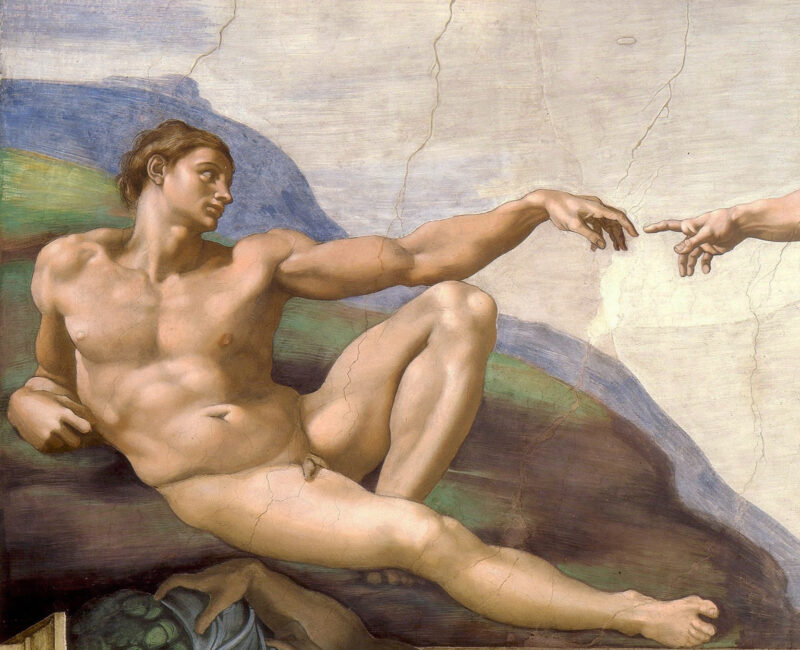
Michelangelo’s ‘The Creation of Adam’
“Well Hung” and the European Colonial Gaze
As part of his research into all matters sexual and cultural, Professor Senelick stumbled upon one of the earliest references to someone “well hung,” and he sent the information to the editors of The Oxford English Dictionary. “The OED lists the first known publication of ‘well hung’ in this sense to be in Randal Cotgrave’s English-French Dictionary of 1611. I found the usage in a letter of Thomas Hobbes a few years earlier.”
It is also in this period that European explorers were sending back accounts from Africa of enormous phalloi on Black tribesmen. They began to take measurements. To the fearful white observer, the “mythically huge black penis” could only signify a bestial sex drive — “proof of the Black man’s link to the apes,” claimed Richard Jobson in his 1623 book The Golden Trade, in which he reported his first encounters with Mandingo tribesmen. Jobson considered their large penises a punishment from God. “The African penis became a source of curiosity, anxiety, and racial discrimination,” writes Dian Hanson, who notes that such stereotypes die hard — which she, in a way, confirms with her selection of photos of humongously endowed Black men in her book. “This becomes commonplace, with the pseudo-scientific conclusion that since dark races are supposedly intellectually inferior and more animalistic, a large penis is compensation for a small brain,” Senelick states. “It also suggests a stronger, uninhibited quotient of sexual passion. These ideas accompanied the spread of slavery and contaminated social attitudes in slave-holding societies.”
Pop Culture, Porn, and the Modern XXL Icon
Centuries later, Long Dong Silver emerged in the 1980s as a symbol of racialized pornography, astounding women everywhere with his exceptionally long penis, which he displayed in porn movies such as Sex Freaks. It later turned out to be a latex construction put on top of his real penis, to give it that unbelievable swing. But the fantasy worked for the longest time. Today, the “Big Black Dick” stereotype is still everywhere, particularly on porn websites, where “BBC” (Big Black Cock) remains one of the most searched-for categories. (The fact that Black men themselves often suffer from this stereotype and expectations related to it is another matter.)
In 17th-century France, “size” was a topic in gossip chronicles of the Three Musketeer period. Senelick found an example where someone jokes that a man only had a couple of inches of wit but made up for it with “12 inches of the other.” In his Historiettes, Tallement des Réaux, writing of the France of Henri IV and Louis XIII, occasionally mentions that a certain individual was exceptionally endowed, making him popular with the ladies. “That’s where the joke about 12 inches appears. It was a period teeming with chroniques scandaleuses, but the language tends to be figurative. One has to read reams of memoirs before lighting upon such a comment.”
Moving into the 20th century, the supersized penis suddenly appears in Pop Art, in works by Andy Warhol and Robert Mapplethorpe, who had to fight to get art galleries to exhibit their “big dick” works, such as the famous portrait of African-American Milton Moore as Man in Polyester Suit (1980), who has his (non-erect) massive dick hanging out of his three-piece suit. That same year Mapplethorpe also photographed Christopher Holly, another Black man, this time with an erect penis in profile mode. And then there is Bob Love, full frontal and awe-inspiring in the dimensions between his legs.
These works took some time to be accepted into art circles, just as Warhol’s various penis drawings, including the works showing the super-endowed window dresser Victor Hugo (partner of fashion designer Halston) in the Sex Parts series. These artworks — sold today at top prices — only recently found their way into museums such as the Neue Nationalgalerie in Berlin, which presented them as part of the 2024 exhibition Velvet Rage and Beauty, after a previous big Warhol retrospective there had not dared to include these XXL penises.
Gay Erotica and Tom of Finland
Both Warhol and Mapplethorpe were gay men and approached the fascination with large penises from a particular cultural angle. In the 19th century, when the image of the homosexual male began to coalesce for the first time, it was of an effeminate, almost eunuchoid type who might admire the masculine attributes he was missing.
“Doctors attempting to classify homosexuals by physical traits could not agree on whether their penis was large, small, average, or unusually shaped,” remarks Senelick. “A term like ‘size queen’ could emerge only when a community or subculture was broad enough to share tastes and habits.”
The “mollies” of 18th-century London or the “warme Brüder” (warm brothers) of 18th-century Berlin may have had a name for fanciers of big dicks (after all, Frederick the Great and his royal father admired big grenadiers), but we don’t know it. The man who changed the image of the homosexual as hypermasculine — the opposite of the effeminate “Friend of Dorothy” — was the artist Touko Valio Laaksonen, better known as Tom of Finland. Not only did he portray men of jaw-dropping muscle definition, but of penis sizes that outdid anything the Ancient Greeks would have classified as grotesque.
Yet it was exactly these gargantuan members and muscles (often clad in leather and military uniforms) that inspired a whole generation of gay men to see themselves in a new light. Interestingly, these Tom of Finland drawings are today also astronomically priced, with a large female base of buyers.
“It’s worth remembering that Tom of Finland developed his aesthetics under the Nazis, and there is a fascistic tinge to his fantasies,” says Senelick. “Despite the occasional minority figure, his men are Aryan brutes, often indulging in sadomasochistic revels. Their oversized pricks, impossible to be constrained in jeans or leather, have little to do with reality but more with dreams of choking and being choked, splitting and being split. His images began as cult figures and were rapidly commercialized.” You can buy cups, towels, bed sheets, and t-shirts with Tom of Finland prints today; and they all flaunt their outrageously huge penises at you as symbols of gay emancipation.

Gay Literature, Songs, and Cultural Humor
In gay literature of the 1970s, the enormous penis is also celebrated by authors such as Gordon Merrick. In his Charlie & Peter trilogy, set in the post-WWII years, Charlie Mills is portrayed in The Lord Won’t Mind (1970), One for the Gods (1971) and Forth Into Light (1974) as someone with an extremely large penis, and everyone around him in New York and later in Europe (South of France and Greece) falls to their knees to worship him, hoping for a transcendental experience when he fucks them. This applies to men and women alike. His partner Peter Martin turns being penetrated by Charlie into an almost religious experience of otherworldly dimensions.
Other gay authors, such as Cole Porter or Noël Coward, mocked big dicks in their songs. Coward wrote an extra set of lyrics for Porter’s famous list-song You’re the Top, adding the smutty rhyme: “You’re the tits of Venus, you’re King Kong’s penis!” Strangely, though published in the official complete lyrics of Porter, no one has ever dared to record this version of You’re the Top until today, neither male nor female singer. Senelick laughs at the lyrics and dryly comments, “Gorillas are supposed to have small penises.” Just for the record, gorillas measure 1.25 inches on an average erection and still manage to impregnate a female gorilla, as science journalist Deborah Blum points out. “So why, exactly, does a human male need five inches or greater?”
The penises from the gay underground world — often shown in porn magazines with titles such as Inches, Black Inches, Latin Inches, etc. — later found their way into a more mainstream heterosexual female market when editors such as Dian Hanson brought them together in her Taschen publication, where she puts a blonde woman marveling at Long Dong Silver on page one, giving The Big Penis Book the semblance of being “not gay” and thus “acceptable” for mass consumption — only to then present image after image from these gay erotic magazines without identifying them as such. You could call that clever marketing or packaging.
Female Desire and Cultural Fantasies
So, are women turned on by seeing these repackaged penises? Psychology Today once found that women who rate themselves as highly attractive are more concerned about penis size than other women: “A large penis, then, may be as much of a status symbol, proof of entitlement to the best that nature has to offer, as it is a pleasure wand.”
Does a huge penis hit more buttons in a woman and thus give more pleasure? “Not all our buttons are so clearly marked and located in the clitoris,” claims Bordo. “Huge, throbbing members may send some people into ecstasy, while big dicks will repulse others. A lot may depend on just what you imagine you have inside you. We could thus poll a hundred people, gay and straight, and probably get a wide range of answers to the question of whether or not size matters to pleasure,” she concludes.
“The magnificently large penis is an icon of cross-cultural potency,” Bordo sums up matters from a female point of view. “From romance novels to the erotic fantasies in the back pages of PLAYGIRL to Ally McBeal, the woman’s first encounter with the male stud’s member is typically one of gasping bedazzlement at the ‘magnificent’ size.”
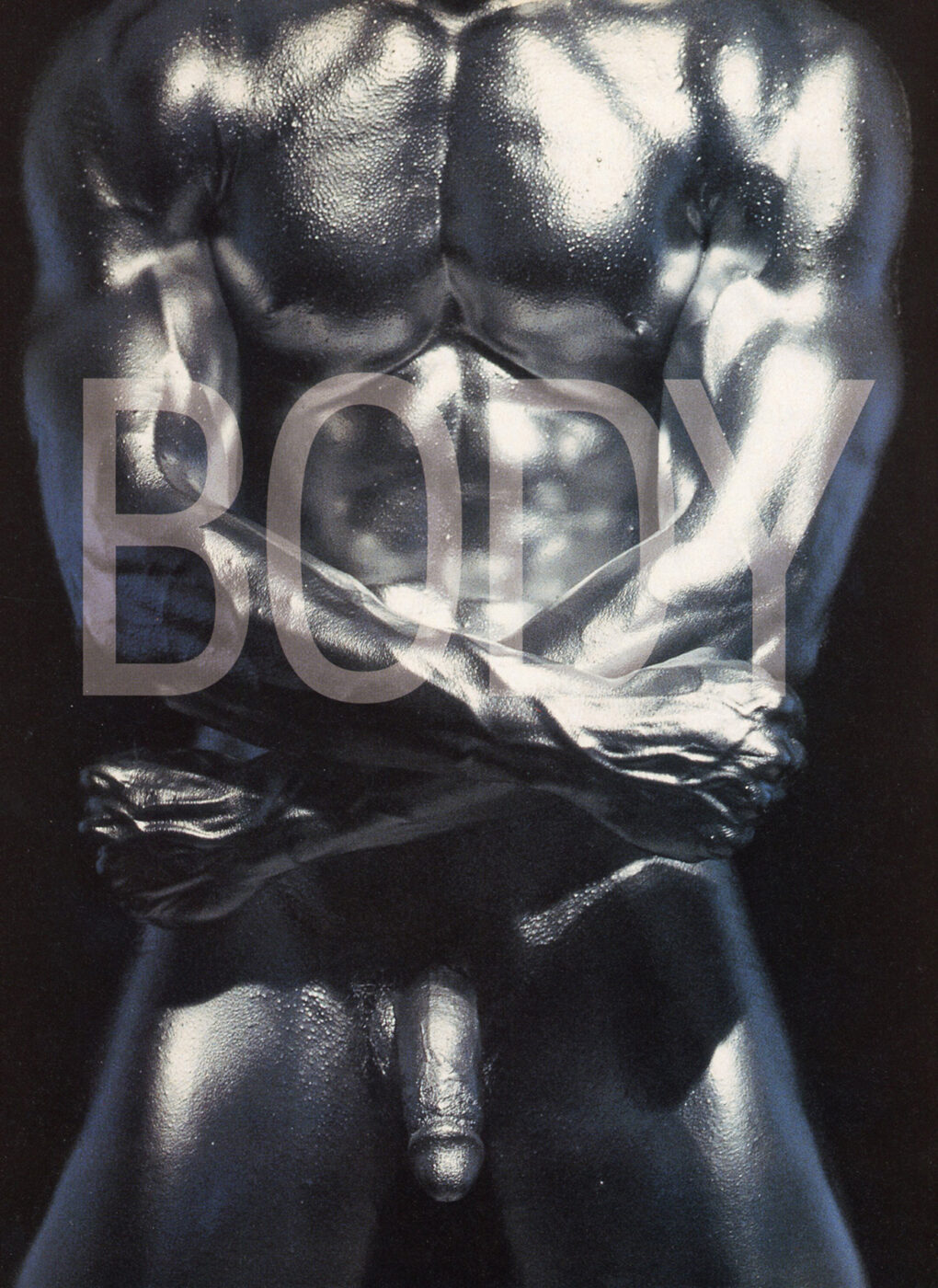
Playgirl.
“The humongous penis, like the idealized female body, is a cultural fantasy. It exists in the flesh,” Bordo continues, “but it is an exception. If a Martian were planning a trip to Earth and was given a Vogue or PLAYGIRL to enlighten him on what to expect from human women and men, he’d get a very misleading impression.”
Hanson places a statement at the top of the introduction to her book, saying: “OK, size doesn’t really matter. A caring, sensitive lover can satisfy his partner with a penis of any size and can most certainly satisfy himself. A big penis doesn’t make a man more of a man, just as a small penis doesn’t make him any less.” Yet she immediately adds: “Who can deny the allure of a big dick?”
Her final verdict is concise and memorable: “Big shoulders, big lapels, and big hair may come and go, but the big penis never goes out of fashion.” Professor Senelick might object, but he laughs anyway, recognizing that there is, in its own outrageous way, a certain delight — and undeniable entertainment — in contemplating these outlandishly proportioned members and their ever-changing evaluation throughout history.
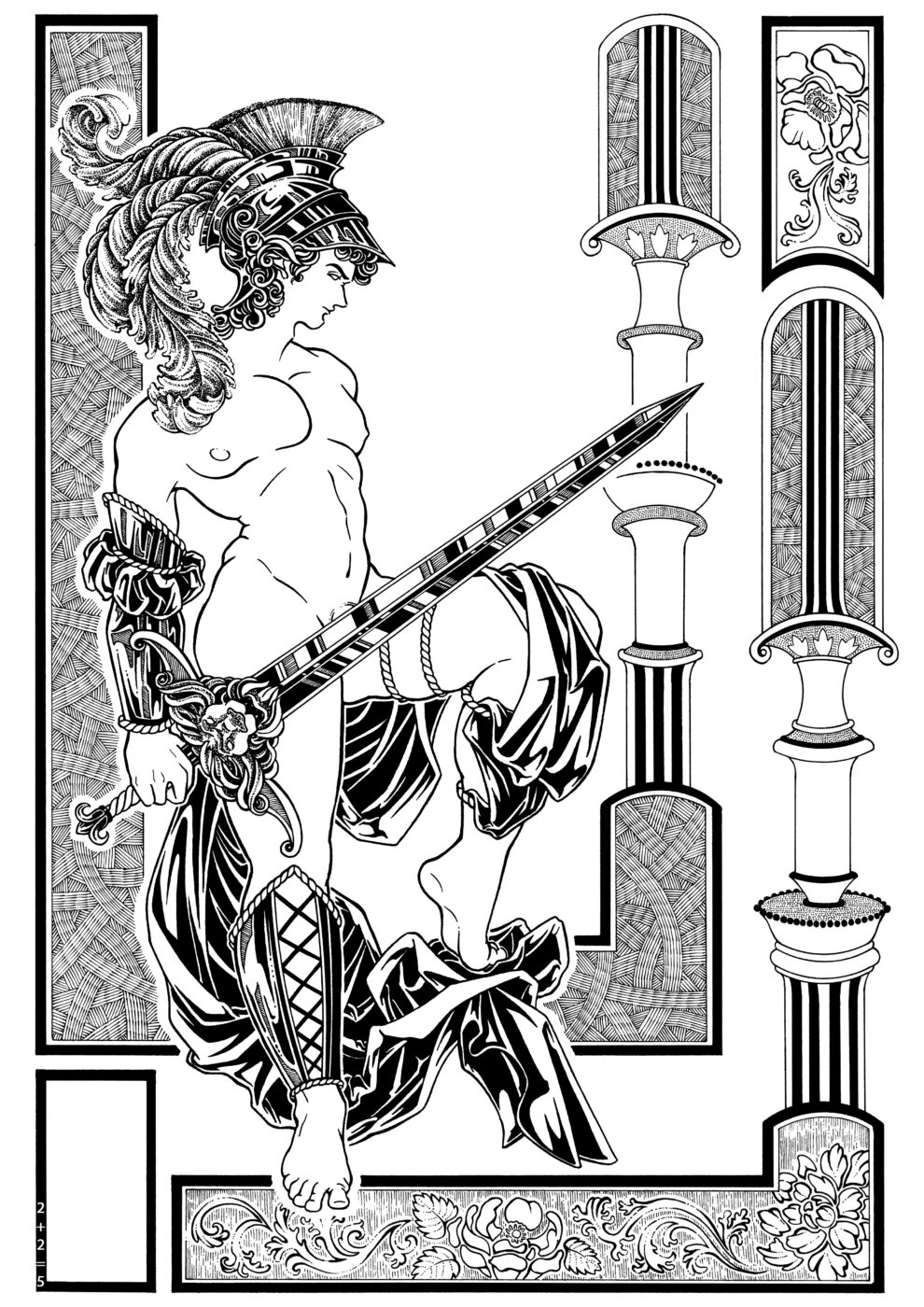
Art: Gabriele Zamboni for Playgirl