
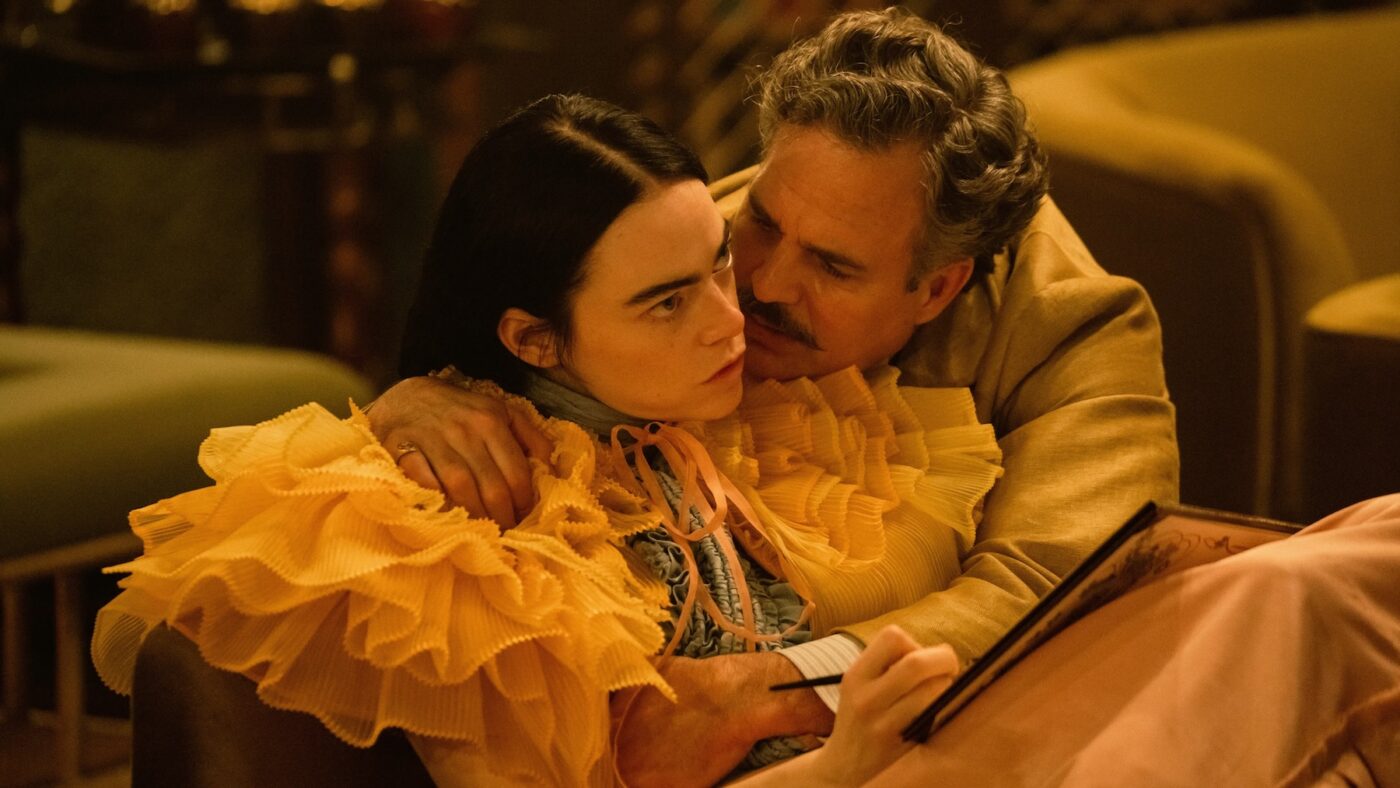
Sex onscreen isn’t what it used to be. Not only are movies featuring less erotic content these days (even R-rated movies are on the decline), but the sex that does make it to the cinema often skews towards the mainstream.
Academy Award-nominated director Yorgos Lanthimos is one consistently fascinating exception. The Greek filmmaker is unconcerned with flash or flattering angles; there is no pandering to the male gaze in his films. Lanthimos isn’t necessarily trying to turn anybody on. Without these constraints, he’s free to show sex for what it truly is, in all its absurd, awkward glory.
“I do enjoy awkwardness,” Lanthimos told Interview magazine. “I think it’s an important feeling for people that maybe generates some kind of thirst to wonder about things. As an audience member myself, I love to be in a position where I’m trying to figure out what I am supposed to feel, or if what I’m feeling is appropriate or not.”
The question of what makes a feeling (and its consequent behavior) appropriate is at the center of the stunning and fantastical Poor Things (2023). If only every woman felt free enough to explore her sexuality with the gleeful curiosity of wide-eyed Bella Baxter, staggering through a Hieronymus Bosch landscape on her journey of self-discovery. It’s no surprise that longtime Lanthimos muse Emma Stone won the Oscar for this magnificently deranged performance. As a newborn woman (resurrected with the brain of her unborn child), Bella has never learned to be ashamed of her body, her urges, or her actions. Herself an experiment, she approaches sex with an almost scientific rigor: When it’s good, it’s good; when it’s bad, it’s bad — but she never questions her own erotic skills or lets herself be diminished by a lousy lay. When she finds employment at a brothel, Bella can’t understand why smarmy suitor Duncan (Mark Ruffalo) is horrified, nor is she particularly bothered by his judgment. (“You whored yourself!” – “Which you are now going to explain to me is bad.”)
‘Poor Things’ • Photo: Searchlight Pictures.
What’s truly remarkable about Bella as a sexual being is that even as she becomes more worldly and gains an intellectual understanding of what constitutes “polite society,” she remains steadfastly shameless, rejecting the idea of a sexual moral code. She refuses to be degraded, even when forced to carry out such seemingly humiliating tasks as allowing a man to demonstrate the most mundane way to make love in front of his young sons.
This scene echoes 2009’s Dogtooth, in which a father hires a security officer to show his son how to have sex. Sometimes (even oftentimes) in Lanthimos films, sex is nothing more than a transaction: Mechanical and devoid of passion or nuance. Take, for example, The Lobster (2015). The residents of a hotel, exiled for being single and tasked with finding a mate (lest they be turned into an animal), are not allowed to masturbate but required to receive “sexual stimulation” from chambermaids. Sex as a mechanical, habitual release might make for a seemingly bleak interaction on film, but it’s certainly not unrealistic.
Lanthimos isn’t afraid of the bizarre or taboo, and some have called certain scenes (such as those fatherly tutorials) disturbing. But the truth is, even the most vanilla sex can be pretty weird, which makes watching Bella Baxter matter-of-factly allow a deformed man to scuttle around like a naked crab before chewing on her hair sort of…comforting.
While sex also plays a key role in The Favourite (2018) it’s viewed through a slightly less strange, though still unvarnished, lens than Poor Things. If the latter is the story of a woman finding her inner strength through sex, The Favourite tells the tale of women using sex to gain a different type of power — that of influence over others, the ability to control.
As the physically and mentally ailing Queen Anne, a brilliant Olivia Colman explores the intersection between pleasure and pain with a thrilling lack of artifice. This isn’t the kind of pain we’re used to seeing associated with sex; we’re not talking whips and chains, we’re dealing with gout. And yet, when her confidante Sarah (Rachel Weisz)’s massage of Anne’s afflicted limb turns sexual, it’s surprisingly hot. Lust prevailing over the kind of physical comfort that comes with disease is a rarely-depicted corner of the sexual universe, but it makes sense that Lanthimos, of all directors, would dare to go there.
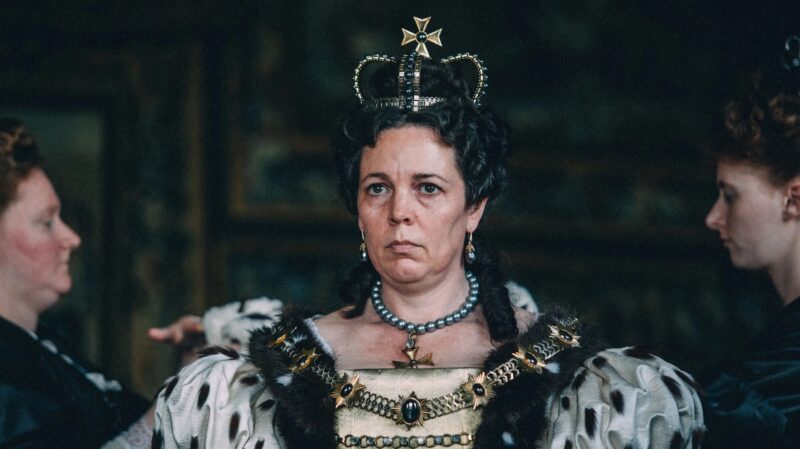
‘The Favourite’ • Photo: Fox Searchlight Pictures.
Anne gets off — literally — on the power she has over Sarah and Abigail (Emma Stone), Sarah’s social-climbing, down-on-her-luck cousin, both of whom use sex to stay close to the queen, gaining power for themselves. The difference is that Anne was born with power, so it’s more about immediate gratification than victory via eros.
It’s not until the final scene, when Anne witnesses Abigail gleefully hurting one of the queen’s beloved pet rabbits (stand-ins for the many babies she lost) that Anne’s power turns cold and cruel; as she roughly grabs Abigail by the hair and forces her to “massage her leg,” the relationship between pain and pleasure once again shifts.
Lanthimos revisits the familiar themes of power, cruelty and control in the darkly comic triptych Kinds of Kindness (2024). In the opening and closing segments of the film, it’s Willem Dafoe pulling the strings: He dictates everything his employee (Jesse Plemons) does in the first vignette, even telling him when he’s allowed to have sex with his wife (Hong Chau); in the third chapter, Dafoe and Chau run a sex cult, forbidding their members to have sex with anyone else (those suspected of infidelity must be tested for “contamination” by having their navel licked). The middle chapter of Kinds of Kindness, meanwhile, includes a spectacularly uncomfortable scene featuring Plemons begging his friends (Margaret Qualley and Mamoudou Athie) to watch a partner-swapping sex tape they made with his missing wife (Stone). While Qualley and Athie seemed to be enthusiastic participants in the making of the tape, they clearly have no interest in a viewing party, but Plemons manages to manipulate them into reliving the moment — yet another type of power play.
When asked in the aforementioned Interview piece about his focus on “unsettling” sexual machinations, Lanthimos said he’s “interested in sharing that part of [sex].”
“It sheds a light on things that interest me more than something that works perfectly,” he said. “And not just with sex, but in any kind of activity. I wouldn’t know what to say about something that worked in a perfect way, so I guess in everything I try to find what doesn’t work, and expose it, and then see how it relates to people and their stories and their character. Sex is no different.”

‘Bugonia’ • Photo: Focus Features.
In a somewhat surprising twist, 2025’s Bugonia (a remake of the 2003 South Korean film Save the Green Planet!) departs from the sexual themes that Lanthimos is known for. In fact, conspiracy theorist Teddy Gatz (Plemons) chemically castrates himself and his accomplice before kidnapping a pharmaceutical CEO (Stone) to avoid being distracted from their mission by sexual temptation. This choice seems significant: In deliberately removing sex from the equation, Lanthimos is once again acknowledging its power.