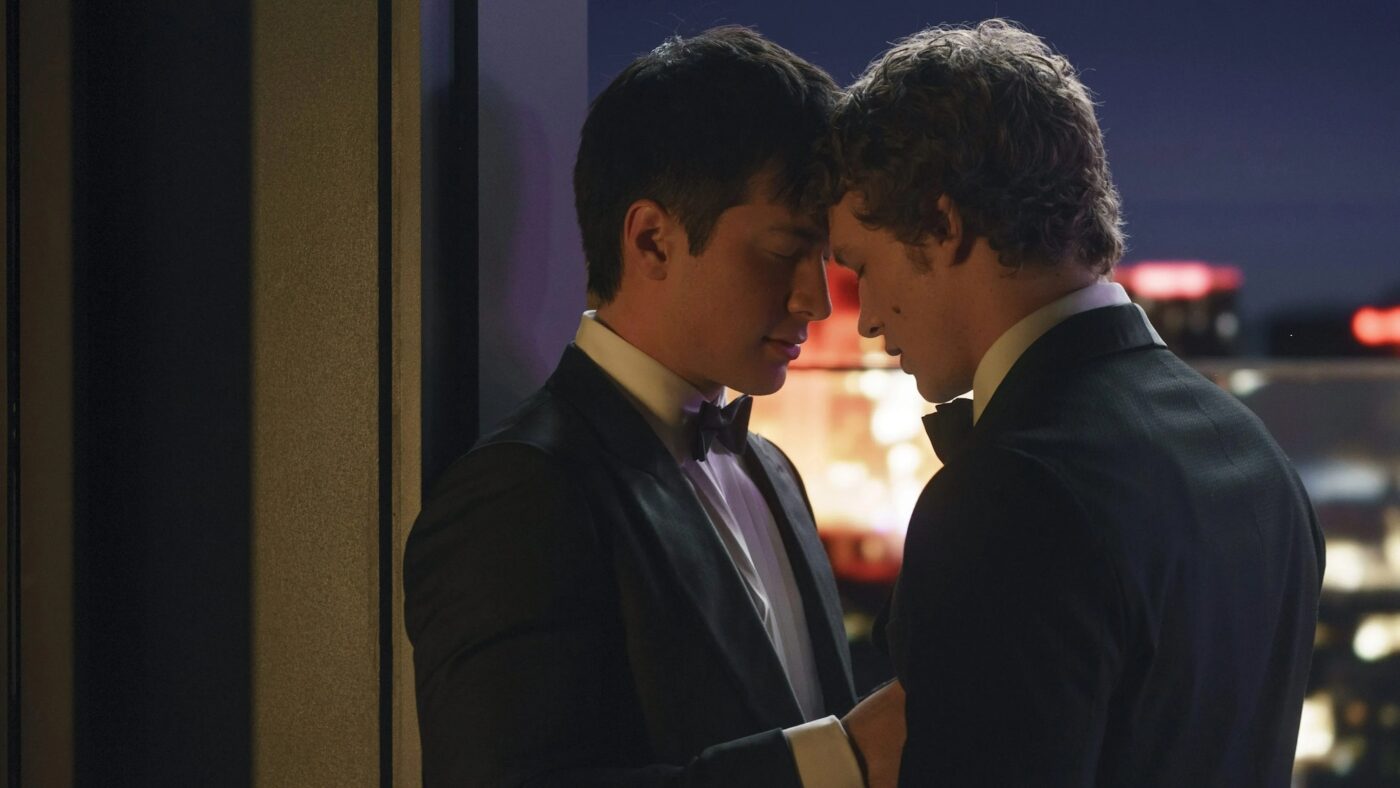
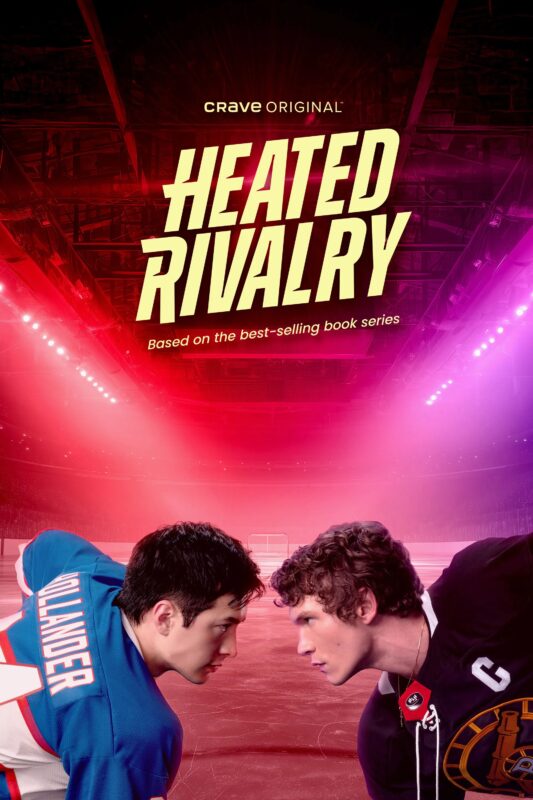
Rachel Reid’s raunchy, borderline-graphic novel Heated Rivalry has been making headlines everywhere, thanks to the popular TV adaptation by Jacob Tierney, starring Connor Storrie and Hudson Williams as rival NHL players who dive into an intense sexual affair.
The vast majority of fans are straight women, who have become utterly obsessed with both the story and its stars, sharing memes, reaction gifs, and hot takes across social media. Originally released by Crave in Canada, the series went viral once HBO Max licensed it and offered it to U.S. audiences. The female fandom—straight, bi, or otherwise—reacted immediately and drove Heated Rivalry’s success: The show became one of HBO Max’s most successful titles of 2025, the book sold out worldwide, and even before the end of season one, a second season was announced in December 2025.
So, what is it that fascinates women so deeply about stories like these? “You’d never think it,” said Tierney in an interview. “But the baked-in audience for this is … wine moms. They love this stuff. And the thing that is so interesting is that the people that don’t know about it are gay men. The women have been waiting for this—and the gay men don’t see it coming.”
As Seth Abramovitch points out in his “Down to Puck: Why Women Are Going Wild for ‘Heated Rivalry’” essay, there’s a long history of women quietly consuming male-to-male erotica. “It goes all the way back to the 1970s and half a world away, to when female manga artists in Japan began experimenting with stories centered on romantic relationships between men,” writes Abramovitch. “By the 1980s, the genre exploded beyond Asia to become a DIY phenomenon globally, with fans pairing off… pop culture characters into fantasy relationships.”
When the internet arrived, these stories burst out in scale. Communities formed on platforms like LiveJournal, Tumblr, and Archive of Our Own, creating a vast, mostly female-driven literary universe that eventually found a foothold in mass-market publishing. Reid’s hockey books also started their life in such online forums.
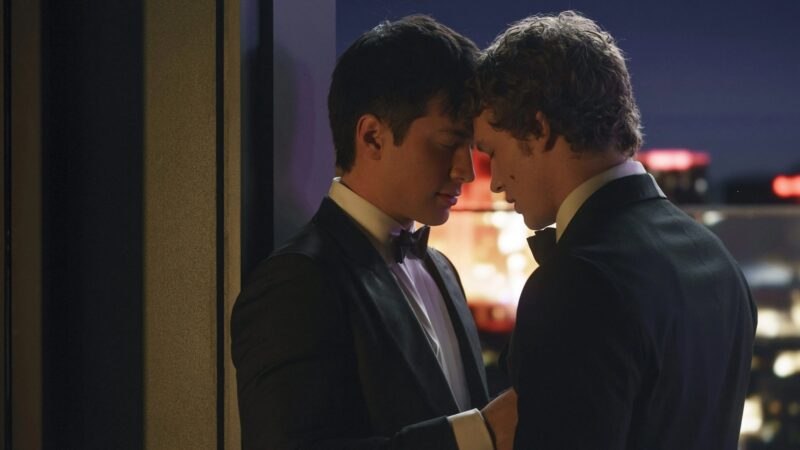
Once Hollywood took notice, it offered titles such as Love, Simon, Call Me by Your Name, Heartstopper, or Red, White & Royal Blue and the results were mostly PG rather than R-rated —lots of swooning, little unapologetic sex. Enter Heated Rivalry: “The most balls-to-the-wall erotic programming to hit screens since Skinemax,” according to The Hollywood Reporter. Two young and previously unknown actors playing Shane Hollander and Ilya Rozanov (Williams and Storrie) were shown in the most alluring, butt exposing positions—while demonstrating a strong chemistry that lifts their bedroom (and locker room) encounters off the screen into a realm all its own. “Who knew? It turned out to be exactly what female viewers have been longing for all along,” remarks Abramovitch.
‘Heated Rivalry’
Which makes us wonder: are there more comparable hockey romances—written by women, for women—that are worth discovering and with similar key ingredients?
What seems to captivate the various authors in this MM romance field are outrageously “masculine” men whom readers get to watch having sizzling sex with each other. These athletes are deliberately presented as “man meat,” juicy, raw slabs of flesh. Much like women were presented in countless earlier novels—as sexual objects designed to arouse the male reader—here the script is flipped. At the same time, these books sketch a utopia: “Female viewers appear drawn by the romance and the toned bodies, of course, but also by the entirely consensual nature of the vigorous raunch, the desire for mutual pleasure between partners, and the relative absence of macho toxicity. It’s not just sex but sensitivity that sells,” claims David Rooney in his article “In Praise of ‘Heated Rivalry’ and Gay Happy Endings.”
Part of the utopia is that we get to see—at least eventually—an accepting society and sports world, one that manages to overcome homophobia, rape culture, and problematic gender stereotypes, allowing the men to live happily together –naturally with the support of their female fans, who prove themselves especially progressive.
Alpha Men and Butt Plugs
Like Reid, the successful writing duo Sarina Bowen and Elle Kennedy caters shamelessly to female desire with sexual candor in their MM hockey series, where the characters James and Wesley—“Wesmie”—are portrayed as “raging horndogs” who fuck their way through three books: Him, Us, and Epic. At times, these alpha males even use butt plugs while jogging to loosen their sphincters so they can better accommodate their partner’s XXL equipment. Bowen and Kennedy seem to take particular pleasure in showing that Wesmie are willing to suffer for their love, because they want their partner to feel good and experience the pleasure they themselves enjoy. These are versatile men, equals in bed, careful to always respect the needs of the other, no matter how rough things get. There’s always a “Is this okay?” before they take the next step. Consent is crucial.
At the beginning of Him, tattooed and pierced bad boy Wesley is estranged from his family in Boston. He reflects on his precarious position: “As the only gay hockey player I know, I walk a fine line. If someone brings it up, I’m not going to shut up and crawl into a hole—but I’m not volunteering the information either. Honestly, my sexual orientation is probably the worst-kept secret on this team. The guys know. The coaches know. They just don’t care.”
But he doesn’t pay much attention to the rules of secrecy himself—until love arrives in the form of his former best friend James, whom Wesley believed to be straight. James, a backup goalie, has lived a heterosexual life—until they reunite. Then things spiral out of control. Wesley seduces James into gay sex, and to everyone’s surprise, James enjoys it. “If I’m going to be gay, I’m going to be a hundred percent gay,” James admits. “Why did nobody ever tell me the prostate is some kind of magical pleasure zone? Are there unicorns dancing there? Orgasm fairies?”
James leaves his girlfriend to be with Wes—a scenario that might seem like the ultimate nightmare scenario for many female readers. Yet, with the female competition out of the way, many readers can fully relax. As porn director Nica Noelle told Vice magazine: “Many older, heterosexual women feel more comfortable watching male-on-male porn because they don’t have to worry about competing with a younger, hotter, or more sexually experienced woman on screen. The gay man rejects all women sexually, no matter how young or beautiful they are. When a woman watches her porn crush with another man, she can enjoy his beauty and sexual performance without being distracted by another woman she feels she could never compete with.”
British MM romance author K. C. Wells shared a similar observation with me, adding: many women read these stories with a vibrator switched on to heighten arousal.
Bowen and Kennedy use the sports setting almost exclusively as a pretext for endless erotic fantasies—sweat, semen, stamina—testing the batteries of their most devoted readers. The back cover of their first book contains the warning: “Sexual situations, hotties on hockey skates, skinnydipping, shenanigans in a SUV and proof that coming out to your family on social media is a dicey proposition.”
Rachel Reid applies a similar strategy in her Game Changers series (Game Changer, Heated Rivalry, Tough Guy, Common Goal, Role Model, The Long Game), combining athletic alpha males, tension, and extensive erotic encounters. The TV adaptation of Heated Rivalry transformed these novels from niche bestsellers into a pop-culture phenomenon. Williams especially is cheered for putting a spotlight on Asian men.
‘Heated Rivalry’ • Photo: Sabrina Lantos/HBO.
Postponed Sex
E.L. Massey approaches MM hockey romances from a different perspective in her Breakaway series, dedicating it to “fan-fiction writers of the past, present, and future.” In contrast to Bowen/Kennedy or Reid, Massey presents a universe in which sex is postponed until commitment, creating a world of trust, domestic stability, and emotional intimacy rather than immediate erotic gratification.
Her characters— rough-and-ready poster boy Alexander Price, the youngest NHL captain ever, the stereotype of an out-of-control athlete, the “embodiment of dirty hockey,” and Elijah Rodriguez, a young mixed-race “femme” figure skater suffering from seizures—navigate the pressures of sport, social media, and coming out, ultimately forming a romantic partnership in a fully accepting environment in book 1 and 2. Massey also shows how the sports world should respond to openly queer athletes, with teammates, management, and female fans confronting homophobia and celebrating love. But she mostly concentrates on showing how supposedly wild boys can be tamed into caring and nurturing partners, despite their previous public image. In book 3 (All Hail the Underdogs) her teenage next-generation players Patrick Roman and Damien Bordeaux—both in a top hockey preparatory school, one a penniless underdog, the other a trust fund baby—even adopt a baby and settle in a house before anything sexual happens on the last pages of the book. One might ask if this is a particular “female” fantasy? I would argue that it is an unlikely gay reality, but it is certainly an “assimilationist” reality –gay life modeled on heteronormative values.
Historical Context and the Utopian Thread
These MM hockey romances are heirs to a lineage of queer sports fiction, beginning with Patricia Nell Warren’s groundbreaking The Front Runner (1974). Warren’s work combined realism with social activism, presenting the challenges faced by openly gay athletes while still delivering an emotionally satisfying story. Bowen/Kennedy, Reid, and Massey, by contrast, focus more explicitly on fantasy, Massey especially takes her readers to a dreamland where they can overdose on “cuteness” (a word repeatedly used in the books to describe situations, alternating with “adorable”). Yet they also operate within a utopian framework of their own, less trauma ridden than Warren (where the hero is shot dead by a Christian extremist), more soothing and escapist. Sketching a dream world readers know isn’t real, but wish it were.
Thanks to Heated Rivalry, all these novels are currently enjoying massive attention. Bowen/Kennedy, Massey, and Reid are now frequently recommended together in “If you liked Heated Rivalry, try this” lists. There are more books to explore, and it’s definitely fun to do so. They all prove that this is not only about “premium smut,” but about a different kind of masculinity being investigated. Yes, these hockey boys are brash and wild, but also extremely considerate with one another and with their female friends. And these female friends, in turn, become their fiercest allies—at least in Reid’s case.
Jim Downs in The New York Times praises Reid for writing “a sweet, sexy, happy love story between two men in which, as she says, ‘the sexual tension and romance isn’t subtext or a tease or something that ends in tragedy.’” This fits what so many gay men have been missing in more realistic indie movies about queer life. Reid’s willingness “to write toward our joy feels rare, and so does the result,” claims Downs: “Our intimacy made central, not symbolic; love scenes that are not lessons; desire that doesn’t apologize for itself.”
So, in the end, it’s a perfect teaming up of women and gay men—conquering the patriarchal mainstream together instead of standing on opposite sides of a divide. Downs calls this “revolutionary.” We’re all watching these hockey players doing things to each other that represent a brave and better world—where men are allowed to be different, lust for each other, treat one another with respect—butt plugs and all.